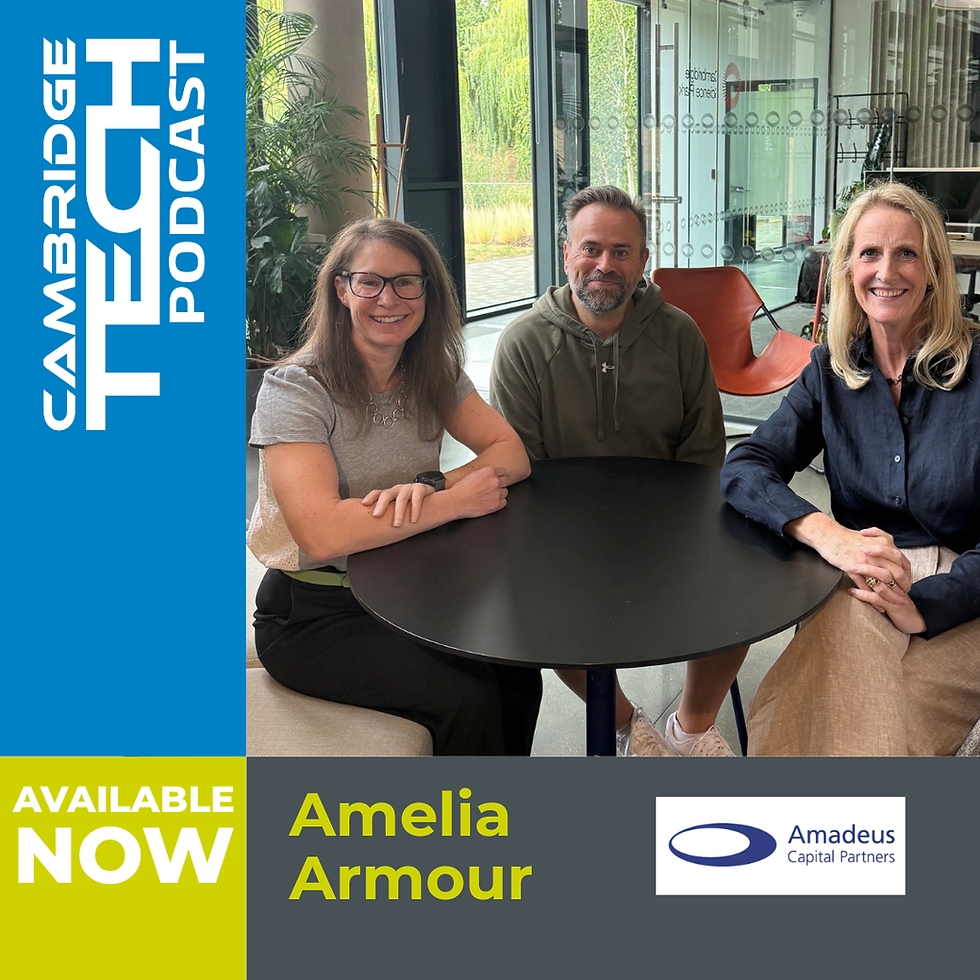
Show Notes 187: From Aerospace to Impact: How Rob Walden Built Ventures That Save Lives
The latest Cambridge Tech Podcast episode is a masterclass in entrepreneurial resilience and the power of Cambridge's interconnected ecosystem. Hosted by Faye Holland and James Parton, this week's show features Rob Walden, co-founder of Engineering the Blue, discussing his journey from aerospace engineering to venture building, and the life-saving technology his team is developing right now.
The Week's Tech Headlines
The Sanger Institute has loaded a complete genome onto IBM's 156-qubit quantum computer. This collaboration between the Wellcome Sanger Institute and universities across Oxford, Cambridge, and Melbourne represents a significant step towards real-world quantum applications in human health.
James flagged upcoming Cambridge tech events worth your calendar space: Google Cloud Office hours and David Cleveley's talk on "Why Innovation is Mostly Accidental" at the Bradfield Centre on 28 April.
Rob's Journey: Three Decades, Three Pivots
What makes Rob's story compelling is how each chapter informed the next. After 15 years at Marshall Aerospace (starting in 1995 with pencil and drawing board), he witnessed the industry's digital transformation firsthand. Then came Pod Point where he joined as employee number five in 2010, watching the company scale to 70+ staff before EDF's acquisition in 2020.
Key takeaway from his Pod Point years:
"The entrepreneurial journey and the innovation journey is not as smooth... you have to wait. You have to dig deep and maintain enthusiasm even when things aren't going your way."
This experience proved invaluable. Pod Point taught him how to build markets before demand exists, navigate regulatory environments, and scale operations against the odds.
The Euthasafe Story: Serendipity Meets Purpose
Fast forward to today. A chance conversation in a garage near Bury St Edmunds with a colleague Rob met 30 years ago at Marshall Aerospace sparked the idea for Euthasafe. A vet mentioned the challenge of securing controlled drugs in veterinary practice. This led to Professor Stuart Reed at the Royal Veterinary College, who'd been developing solutions to address a tragic reality: suicide rates among vets are 2-4 times higher than the general population, often involving misuse of animal euthanasia drugs.
The solution combines:
A lockable drug box with app-based access control
Location and time-based restrictions
"Means safety" principles—soft barriers that reduce access to lethal means
Offline functionality (crucial for rural vets with poor connectivity)
The pilot tested 25 boxes across 40 vets in seven practices. Feedback was overwhelmingly positive, with initial scepticism falling away post-trial.
What's Next?
Euthasafe is raising £850,000 to complete certification, enter production, and scale UK operations. Rob is targeting angel investors with veterinary connections, recognising that vet-backed funding signals professional endorsement.
But there's a bigger vision here. The technology has patent-pending status and potential applications across controlled drug storage in palliative care, dentistry, and beyond.
Why This Matters
Rob's final advice to aspiring founders is worth highlighting:
"Networking is key... Cambridge is a very giving and forgiving place. If you ask people for advice, they tend to help or send you somewhere to get good advice."
This episode perfectly captures why Cambridge remains a unique ecosystem: it's not just about deep tech and venture capital. It's about people solving real problems, staying connected across decades, and building businesses that matter.
Listen to the full episode now on the Cambridge Tech Podcast—and subscribe so you don't miss future conversations with founders changing the world.
AI Generated Transcript
00:03
Voiceover
Welcome to the Cambridge Tech Podcast, talking all things technology from the heart of the UK's tech capital. Here are your hosts, Faye Holland and James Parton.
00:28
James Parton
Welcome to Cambridge Tech Podcast. Things are still a little bit slow due to Ether, so just one main story to share this week. Now we talk about Quantum on a regular basis on the podcast and one of the common talking points is when will it be ready for real world applications? Well, this week we've taken an important step towards that. The Sanger Institute has secured a world first that scientists have loaded a complete genome into a quantum computer. A major step towards using quantum computing to tackle some of biology's most complex bioinformatic challenges. The breakthrough comes from a collaboration between the Wellcome Sanger Institute and the Universities of Oxford, Cambridge and Melbourne and the Kiev Academic University. As an additional partner, the GEOM was loaded onto an IBM quantum computer powered by the company's latest 156qubit Heron processor.
01:22
James Parton
The project aims to accelerate the application of quantum computing in human health, which may pave the way for faster tracking of infectious disease, deepening understanding of genetic disorders and more accurately identify disease causing mutations. Certainly something we'll be keeping an eye on. Now a reminder to sign up for the bi weekly Google Cloud Office hours by visiting BradfieldCenter.com, click on Community and then click on Events. We'll actually have Alexandra Belliard from Google coming onto the show soon to share more about Google's AI technologies and their work within the Cambridge ecosystem. Also a quick shout out friend of the show, David Cleveley delivering a talk entitled why Innovation is Mostly Accidental at the Bradfield Centre on 28 April. So visit the same website to find out more and to grab yourself a space. Okay, so let's move on to this week's interview.
02:16
James Parton
We meet Rob Walden to talk about his startup Euthrastafe.
02:26
Faye Holland
Hi Rob, welcome to Cambridge Tech Podcast. It's great to have you with us today. So why don't you just start by introducing yourself and telling us a little bit about yourself.
02:35
Rob Walden
Sure. My name's Rob Walden. I co founded a business called Engineering the blue after nearly 30 years in Cambridge with a co founder that I met a long time ago. We're a tech consulting business that does venture building and things like that and I'm very happy to talk about how we got to where we are and what we're doing at the moment.
02:52
James Parton
Excellent. Yeah, we'll definitely dive into that. So Rob, you've lived and worked your whole life in Cambridge. How's the City shaped you both professionally and personally, do you think?
03:01
Rob Walden
So I came to Cambridge in 1995 on a placement year from university. So I studied aerospace engineering at Loughborough and I came to work for Marshall aerospace back in 1995. Marshall Aerospace was a company that was involved in most of the world's big aircraft programs to some level. And there was a busy design office with 350 people in it and it was a great place to learn as a youngster without that highly regulated environment and things like that. So I, I liked Cambridge, found Cambridge a very interesting place to be. So I went and finished my degree and came back to Cambridge, found a partner in Cambridge, lived in Cambridge, got married, had kids, all those things. And I've been in Cambridge ever since. So I stayed with Marshalls until 2010 and then went and worked in London for Pod Point.
03:43
Rob Walden
PodPoint was a startup when I joined it, so I think I was number five on the payroll at PodPoint. And then I stayed at PodPoint until a year after the sale of PodPoint to EDF. So that was 2021 and then I founded this new business with my co founder Steph. So sort of a long journey, but. But really two big things in my career. 15 Years at Marshalls and then 10 years at Poppoint.
04:04
Faye Holland
Yeah, so. So let's pick both of those just a little bit more. Then you said you were in Marshalls from the mid-90s and I guess there you were working on a whole range of different things. So what did being in that environment teach you? You'd come in from academia, you've then landed, excuse the punishment, landed at Marshalls. What did that environment teach you about engineering at scale and what your responsibility was as an engineer?
04:32
Rob Walden
The aircraft industry obviously is highly regulated. There are big teams of people and often international teams and multiple contractors and subcontractors in them. So you learn to be very organised, you learn to communicate well because all of those projects require lots of organisation and communication. I work with customers all over the world, so Spain, Denmark, America, New Zealand. So I traveled around a lot with Marshalls as well. It was a great place to sort of get all of those experiences and be part of teams with people that had seen and done lots of things all around the world. Really. It was a relatively low tech place when I joined. I can't say that's probably not fair. First joined Marshalls, were drawing on drawing boards with a pencil.
05:15
Rob Walden
Seems antique now, but that was how aircraft were designed at the time and the work were doing at the time. It all changed in my 15 years there to CAD systems and computer aided manufacturing and stuff. So Marshall's evolved a lot in that time as well. The big projects I was involved in was an autopilot for South Africa. So that was a supplier in France and customer in South Africa and an aeroplane in Cambridge and a very international team speaking often three different languages. So that was quite interesting. And then later on a big project for Boeing building fuel tanks for the Boeing 777. A lot of that fuel system was designed and made in Cambridge, which people don't really know. Actually. It's quite a surprising thing, the things that Marshalls used to do.
05:57
Faye Holland
Yeah. And there's nothing wrong with a pen and paper, by the way. I'm still a huge advocate of writing things down.
06:02
James Parton
Talking about the Cambridge, the city and the. The ecosystem in Cambridge. One of the fun things, when were chatting in the preparation for this interview, you mentioned Shy's Enterprise Tuesdays and. And we've obviously had Shai as a guest on the podcast before. And bizarrely, as I was typing up my notes from our conversation, as I literally typed his name, he tapped on the Shy.
06:23
Rob Walden
Makes sense. You drifted in.
06:24
James Parton
He tapped on the side of the office glass and it was very odd. He just popped into the Bradfield Centre. But talk to us about the importance of Enterprise Tuesday and the entrepreneurial kind of culture in Cambridge and what sparked that triggered in you from switching from more of a. I guess you could say a corporate role at Marshalls into that interest in entrepreneurship.
06:42
Rob Walden
Yeah, sure. So I was always interested in business and how businesses make money and businesses make things happen. I stumbled upon Enterprise Tuesday. So I used to sneak into lectures in Cambridge in the afternoons and evenings when I wasn't at work. When I was younger, I looked more like a student and I found Enterprise Tuesday. I went to all the Enterprise Tuesday sessions. I thought they were fascinating. Met interesting people, met Shy and then a few years later, Marshalls paid for me and another colleague at Marshalls to do the Ignite summer school. It wasn't called Ignite at the time. Back in 2005, met Peter Hiscox there and other people. Peter became chairman of podpoint. So there's that.
07:19
Rob Walden
Networking served me quite well actually in terms of meeting good people and maintaining those links and keeping talking to people and Enterprise Tuesday or whatever those things have become. I really recommend people to go to them. They're fabulous opportunities in Cambridge to learn things for no money, actually, doesn't it?
07:35
Faye Holland
Yeah. To learn things and Also to make those connections.
07:38
Rob Walden
Make those connections.
07:39
Faye Holland
So leading on from that, you just brought podpoint up again. You'd said earlier on you were employee number five and you stayed with the company right through to the acquisition of edf. So we never make an assumption here. Can you tell the listeners a little bit about who Pod Point is? And then what was it like being in a company that was building a marketplace from scratch?
08:02
Rob Walden
Podpoint was one of the very early companies building EV charging Systems in the UK. So I joined in October 2010. There were a very small number of EVs on the road in the UK in October 2010. Almost a vanishingly small number. It was an event, if you saw one. So I started in a sales and business development role for podpoint, and then that role evolved over time into an operations role and then finally a tech director role, looking after hardware development and supply chain and things like that. I think I moved there from Marshall, so I moved from an organization of thousands of people where there were offices, systems, processes to everything, to an office with five of us where if anything needed doing, one of the five of us had to do it. And that was a fascinating experience.
08:47
Rob Walden
I enjoyed it because you are your own boss. It's all in your gift to make things happen. Right. Pod Point was I enjoyed nearly every minute of my time at podpoint and seeing that business grow. I think I remember us hiring our first electrician when I left, there were 70, 80, 90 of them. I remember us setting up contracts with factories and wondering how we'd sell the 300 products we ordered. And then were building hundreds a day towards the end of the time there. So I remember all of those changes and it's interesting how the problems evolve over time. One memorable day, the factory rang and said, we can't ship all your product because it won't fit in the courier van that's arrived to collect it.
09:23
Rob Walden
And it's not a problem you envisage having because you think those things get solved and we fix those problems bit by bit as you go, and built a very successful team of people to do it. As I say, I stayed until EDF and Legal in general bought the business in February 2020. And then I stayed for a year. So really exciting times. I intended to commute into London for three years when I took the job in 2010, and it took 11. The entrepreneurial journey and the innovation journey is not as smooth, I think were. We were raring to go and the cars didn't come and that's a. That slows up mine. Right. You have to wait.
09:59
James Parton
Yeah, that was going to be my kind of follow up question. I mean, being so early in a market and building like the enabling technology for when the demand isn't there. What kind of lessons or challenges did you go through in terms of convincing people that this market actually had potential?
10:14
Rob Walden
I think a few things. The regulatory environment isn't there, so you have to be prepared to talk to regulators and help define that regulatory environment. You have to be prepared as a tiny company to argue with regulators, say, well actually we want to do something different that's not necessarily covered by the regulations and find a route through that. That's a real thing that happened. When it slows down and when it isn't going your way, you have to dig deep and do that. And were quite good at maintaining that enthusiasm even in, even when things were not necessarily going particularly well in terms of the way we want the market, the way we wanted the market to grow and the way we want things to happen. So that was quite an interesting. Well, it was a very interesting journey.
10:52
Rob Walden
As I said, I loved nearly every minute of it.
10:55
Faye Holland
That's brilliant. Great insights there. So you then after podpoint, you mentioned that you then founded Engineering the Blue. So what made you want to change from that startup environment that you clearly loved into more of a consulting kind of function?
11:14
Rob Walden
Sure. So I did some technical consulting at Marshalls, so I was familiar with that environment. I think I wanted to do startup again. I enjoyed that early stage business sort of journey. What we're trying to do at Engineering the Blue is venture building. So we will take on any part of an innovation journey. We've done project turnaround, product project turnarounds for people. We've done our own in house innovation, we've worked with academia on innovation, so we've done multiple different projects that one of which at the moment we're trying to spin out of the Royal Veterinary College. So that's the beginning of my conversation with James. So those things are quite interesting to me and to my co founder. We quite like that startup environment of, oh well, actually there are only the five of us. So how do we solve this problem? Right.
11:59
Rob Walden
We've got to figure it out with the limited resources we have. And we want to build businesses and projects and products and things that help people. We're engineers at heart and that's what we like to do.
12:09
Faye Holland
So you're getting the best of both worlds.
12:11
Rob Walden
Yeah, indeed.
12:12
James Parton
So that nicely brings us up today. So in true Cambridge style, it was a Chance conversation with a colleague that you'd known for years that resulted in the idea for Euthasafe. So can you tell that story and explain what immediately stood out for you?
12:27
Rob Walden
It's a bit of Cambridge serendipity and those long links and soft links you have with people. So bizarrely, the first guy that I worked with when I walked in the door at Marshall's in 1995 was a fellow Loughborough graduate who had been at Marshalls and elsewhere in the industry for a number of years. He's a good deal older than me, he's now retired and lives near Bury St Edmunds. I was visiting him to talk to him and I was standing in his garage talking and a vet walked in and started talking about the problem of securing controlled drugs in veterinary practice. That chance conversation led to a meeting with Professor Stuart Reed at the Royal Veterinary College.
13:05
Rob Walden
Stuart had come up with the concept for a lockable box that secured those drugs because of a tragedy in veterinary practice, which is the increased numbers of death by suicide among in the veterinary community, usually as a result of misuse of drugs intended for animals. So Stuart had come up with the idea and was looking for collaborators to make something happen. We had some good conversations that resulted in some money coming from the Royal Veterinary College to us to develop a product and run some trials. We're now trying to spin that business out of our VC to scale it up and supply these systems to vets. But it goes back 30 something years to the first guy I ever met at Marshalls and keeping in touch with him a really strange course of events.
13:51
Rob Walden
And if I'd have been 10 minutes earlier or later, it possibly wouldn't have happened.
13:55
Faye Holland
And it's always, it never ceases to amaze me the conversations that we have on this podcast and were the embryo for an idea comes from, and there are many different instances. But I guess here it's the conversation I know you had with James preparing for the episode. Is that fact you've just said about suicide rates two to four times higher than the general population within vets? So it seems something has to be done and that I guess that was the impetus for doing it because of the conversation that you had. But what do you think in terms of developing new ideas and them having a root cause like that you're trying to address?
14:34
Rob Walden
Yeah, I think it was something that I can pull an experience from podpoint and it's a similar thing. So we like to look at the meeting points or overlap between different industries. So if you think about podpoint, you had the vehicle industry, the electricity industry and the built environment industry. And the three didn't necessarily talk to each other very much. And were trying to do something that overlapped all three for vets. Vets don't necessarily do technology or innovation and again, just trying to join up, we're trying to innovate a new thing and it involves bringing some technology to play into this, the veterinary environment. So I think that was part of that journey. Identifying there's opportunity here because we know something. We know about designing product and highly regulated industries and controlled systems and like Internet of things type thinking.
15:28
Rob Walden
The vets know about their problem and the need to, how they had, how they handle these controlled drugs. And then seeing that there is a market opportunity for it isn't just an interesting academic exercise. There is a market opportunity because the same problem exists in Europe, in North America. So we can potentially come up with something that's going to scale in quite an interesting way. It made sense to us to get involved because we could see the additional benefit, if you like, of doing that work.
16:04
Voiceover
Technology moves fast and now so can you. Discover polestar, the all electric performance brand vehicles redefining how we drive. Precision engineering, minimalist design and software that evolves with you. Experience it at Holden Group in Norwich and Bury St Edmunds or let us bring the test drive to your door. Proud sponsors of the Cambridge Tech Podcast Polestar Electric Performance Redefined. DiscoveroldenGroup.co.uk Polestar.
16:40
James Parton
So in that conversation you explained to me that within the veterinary practice there's quite strict controls around access to those drugs, but once the vet goes into the field, it's a lot looser, I guess, in terms of access and control. So maybe for the benefit of listeners that didn't have that chance to have that conversation with you, could explain how that works today and why it hasn't been addressed sooner.
17:02
Rob Walden
Yeah, sure. So vets are often lone workers, so we'll often be out treating animal on their own. The drugs that they would use to euthanize animal are some of the most toxic drugs available anywhere for any purpose. They have to be kept under, in locked storage. The regulations require it, but the approach is typically a mechanical lock. So if you have the key, it means that someone who hasn't got the key can't get into the box, of course, but it means that you, as the vet, can get into the box and no one knows you're accessing it. So the system we've developed with Stuart Read and the rvc. There's an app and the app gives you a PIN number to enable you to access the box.
17:39
Rob Walden
So the app, someone knows you're trying to access the box and you can lock based on location or time. So if the vet's not supposed to be working or the vet's in the wrong place, the app won't give you the code for the box and then you can't get into the box. It just provides this extra layer of oversight and control around those drugs to reduce the chances of that misuse. The technology should prevent try something else. We've introduced something called means safety into that technology flow. Means safety is the. Is putting soft barriers between someone with suicidal intent and the means to access the means to take their own life. By putting those barriers in place, you reduce the chances that someone will get all the way down that path.
18:25
Rob Walden
That was research done by a researcher in Denmark called Marita Nordentoft and then some researchers at Auburn University in the us, led by Professor Tracy Whitty.
18:35
James Parton
I think what's really clever, one of the design aspects you've considered is obviously vets work in remote, isolated situations, so the app doesn't need network connectivity to function.
18:45
Rob Walden
Right. Part of our design development, we talked to lots of vets and they're like, don't make this an Internet connected device. Because in the fields where we treat animals, there often isn't any Internet signal. So you don't want to frustrate their ability to treat animal. We wanted to merely add guardrails around the misuse of those drugs.
19:06
Faye Holland
So you've seen the need, you've looked at the research, you've come up with something that is got the best chance of working and you've run a series of pilots, prototypes on it. What did you learn from those different phases? Did anything significantly change?
19:24
Rob Walden
Yeah, sure. We built 25 controlled drug boxes. We distributed them, I think, to 40 vets in seven different veterinary practices as part of that funded trial. The feedback we got was overwhelmingly positive. Vets were more likely. Their skepticism fell away. So when we had vets that were sceptical about it, they were less sceptical at the end of the trial. So that was an improvement. There were a few bits of feedback. It needs to be very robust when vets handle it in the field. So we have some technical changes to make the device more robust. There was some debate about colour, so we put the drugs in a very brightly coloured box. Some of the vets we talked to said, I like the fact that it's in a brightly coloured box because they won't forget it or leave it anywhere.
20:07
Rob Walden
Other vets were like, actually, when we are euthanasing a family pet, a bright yellow box doesn't sit well and we'd like it to be a more somber color. So we had a few bits of useful feedback like that. We're currently halfway through a slight technical re spin and we'll do a further trial of a slightly revised system just to make sure we've answered those questions. And then we're into running a seed round and raising some money to scale up and get it into production and get it on sale.
20:34
James Parton
So I'm sure one of the questions the investors are going to be asking you is what does the market look like, that kind of opportunity? You know nothing about the veterinary industry. Is it very fragmented? Are there large purchasing kind of groups? How does that work?
20:46
Rob Walden
It is a very fragmented industry. Veterinary practices range from one person businesses to internationally owned large practice groups. They typically buy their things from wholesalers and other system suppliers. Connected IoT type devices are fairly rare in veterinary practice. So we have a new path to forge there to work out how to sell that with a. Because we're selling a device with a contract with it that sustains it the. The market size in the UK. There are 35,000 vets in the UK, of whom 27,000 work on animals, so that's kind of the. The upper limit for the uk. Proportionately, it's the same in Europe and North America. So there are more that we will look to a future fundraise to launch in those markets because the problem's the same and the technology would satisfy the need in those markets as well.
21:36
Rob Walden
And then there are bigger markets in other controlled drugs. So we are talking about the dangerous controlled drugs that are misused by vets at the moment, but also vets have to secure ketamines and other things that they carry around. So we have other opportunities with other veterinary drugs. So we've got a roadmap of technology and where we want to take it. As you say, the market's quite fragmented, so we have some learning to do about how best to access it.
21:57
Faye Holland
The business model is quite an interesting one because you get that the price for the box and then the subscription, so you get the ongoing revenue, don't you? Was it literally just a case of you have to give them a box and therefore we'll come up with an appropriate price for it, or was there anything more conscious in the decision of doing both things and where is the price point landing at we trialled a.
22:21
Rob Walden
Number of different prices with vets, so we did a market survey at London Vet show and some sort of face to face interviews and survey work. There has to be a price for the device and a subscription. So we trialed a all in subscription. So you start paying the subscription, you get the box. Vets prefer to pay something up front. I think that everyone's familiar with a mobile phone contract. We all do that, right. You pay some money up front and get a phone, you pay subscription. So I think that it's a familiar model. We're currently targeting a price point for the box of about £650 and a 10 pound a month subscription with some variations. So there's a lower price for the box and a larger subscription. That seems to work and fit fairly well in veterinary practice.
23:00
James Parton
Obviously you need to remain focused, especially as you're pre fundraising, but I guess there's going to be quite a lot of different applications you could potentially go into in the future. When you think about other harmful substances, weapons, dentistry, other medical kind of professions, I guess there's a big opportunity sitting in front of you.
23:17
Rob Walden
We have a patent pending at the moment for the technology, the kind of technology stack. There are lots of opportunities to introduce means, safety around things that present hazard. So there are lots of palliative care drugs stored in people's homes, for example. So we're aware there are many potential applications of this. The first one that came to us was the issue around vets and their wellbeing. But we're well aware that we maybe have some technology that can apply in multiple different places and we will explore those in I guess a logical order when we get funded and get the opportunity to do so.
23:51
Faye Holland
And what happens if someone comes knocking on your door saying, I've just heard this podcast, what about developing something for us? You'd be very successful.
23:59
Rob Walden
Yeah, we'd love to hear from them.
24:00
Faye Holland
It's scalable.
24:02
Rob Walden
Yeah, scalable and a great opportunity.
24:04
James Parton
So right at the beginning of the conversation, we talked about your personal journey and how you took advantage of the Cambridge ecosystem. How is Cambridge helping Euthasafe at this stage of its development?
24:13
Rob Walden
Yeah, so I think Cambridge is a great place to develop this kind of technology. I think I said that to you when we first spoke, James. So we found nearly all of our suppliers within 50 miles of Cambridge and most of them within 20 miles of Cambridge. There are plenty of people around here that can make things. So having that knowledge of the local supply chain, in part because of my time at Marshalls. And also because I'm nosy and like to look around industrial estates and see who can make what. It's a really useful place to do this. There are plenty of small suppliers around as well. If you need some help designing a circuit board, you need some help designing a piece of plastic.
24:47
Rob Walden
You can find people in the Bradfield Centre, in St. John's in other places that can help you with that work. And I think we've lent quite heavily on that local network of people, both in this project and with other projects that we've done. It's a fab place to do that kind of work. Actually, I think it's fairly unique. I don't think it's the same everywhere. I think it's a Cambridge thing.
25:06
Faye Holland
It's interesting. It's telling the story again, isn't it? I know that the Cambridge and Peterborough combined authority at the Cambridge Chamber of Commerce, they're constantly trying to showcase the businesses that are within the local supply chain. And Marshalls is a great example of supporting the subcontractors and other people that can help the business. Why don't you think that story gets told enough?
25:30
Rob Walden
I think possibly people don't know. For the smaller fabricators around that design and make things on the industrial estates in Haverhill and Newmarket and in the surrounding area, I think it's hard for them to get that story out. There's no central catalog of them. It's not like a maybe not events for them. I don't know. I went to the Southern Manufacturing show in Farnborough last week. There's a room full of hundreds of businesses that make things, everything from folded pieces of metal to circuit boards and electronics. We don't seem to have a show like that in Cambridge. It doesn't seem to be an event like that in Cambridge. So maybe that's a thing that the ecosystem should think about to bring all those people together and let. So I don't have to drive to Farnborough to meet suppliers.
26:10
Rob Walden
I could maybe drive to somewhere in Cambridge to do it. That would be kind of useful.
26:13
Faye Holland
Yeah, no, I think that's a great idea.
26:16
James Parton
So you touched on, then fundraising is, I guess, a next big milestone in the company's development. What kind of investors you talking to? What kind of size of round are you looking to raise and what will that money allow you to do?
26:26
Rob Walden
We are looking to raise £850,000. That should get us to a steady state and profitability in the uk. So device finished and certified in production team built to deploy it and sell it in the uk. We're looking for angel investors with a connection, hopefully to the veterinary world. So we've had some advice from some angels and things that if we can find angel vets to do this, that would be a good start because a vet putting their own money into it says that it's supported by the profession and the community. There are some angel networks around for vets and some animal health angel networks.
26:58
Rob Walden
So we're talking to some of those, we'll talk to some of the other people in the Cambridge ecosystem about it because the other uses of that technology, this might end up being something that the vet part is a relatively small part of eventually, but for the moment it's our main thrust.
27:12
Faye Holland
We talk a lot about deep tech companies in Cambridge, but we do have vet and companies as well, like Vetct with Victoria Johnson was acquired a good few years ago now. So there is some expertise in the ecosystem that I think you can also tap into. So as part of the plans, are you going to be recruiting, are you looking at expanding the team?
27:33
Rob Walden
So our model is we will need to recruit a team to do most of this work. We're a small team at the moment. We cover multiple roles, all of us. So that funding will enable us to recruit people that are dedicated to doing this full time and scaling that business up. So we know the people we're looking for, but marketing people, tech people, operational people that we need to build a full functioning business with that money.
27:54
James Parton
And just reflecting on what you said during your time at podpoint, having that kind of maintaining enthusiasm during those kind of challenging times when you were pre market and trying to sell the vision, I guess with the new business, it's a very deeply human problem you're solving. Right. So you are going to directly save lives with this kind of product. So that must keep you motivated to keep the mission going.
28:17
Rob Walden
Absolutely. I think if this saves lives, it's an absolutely worthwhile thing to do. And we're aware that there's a real problem there. And if we can do something about it and use technology to do something about it, that's a really worthwhile thing to spend time on.
28:30
Faye Holland
Rob, it's been fascinating talking to you. I guess my last question for you is looking back at all of the different experiences that you've had, what advice would you give to someone else who's listening that's maybe thinking of setting something up that can help some big societal problem?
28:48
Rob Walden
I think the networking is key, so talk to lots of people. All advice is good advice. So we endlessly talk to people about our project and what we're trying to do to get feedback and try to understand. So I think the networking is really good. I think as well the early engagement with the enterprise community around Cambridge. So be that ever Enterprise Tuesday has become. I don't know what people go to now that's like that, but those discussions are really useful as well. Cambridge is a very, I guess, giving and forgiving place. If you ask people for advice in Cambridge, they tend to help or will tell you who can. That's one of my bits of I talk to people and they will invariably send you somewhere to get some good advice if they can't help themselves.
29:29
Faye Holland
Yeah, that's great advice. Thank you so much for sharing it with us and thanks for being with us today.
29:33
Rob Walden
It's a pleasure. Thank you.
29:40
Voiceover
Today's show was produced by Joe Donaghy of Cambridge TV and supported by our media partner, Business Weekly. The Cambridge Tech Podcast is available on all major podcast platforms and on cambridgetechpodcast.com if you've enjoyed this podcast, please give it a five star review. It'll really help others discover the show.
Now you can get directly involved with the show. Leave us up to 60 seconds of audio by visiting CambridgeTechPodcast.com on your computer or phone and click Call the Show from the menu. Send us your news items, events to promote, Leave us feedback or suggest a guest.

To listen and subscribe, search for ‘Cambridge Tech Podcast’ on your favourite podcasting platform or visit cambridgetechpodcast.com.