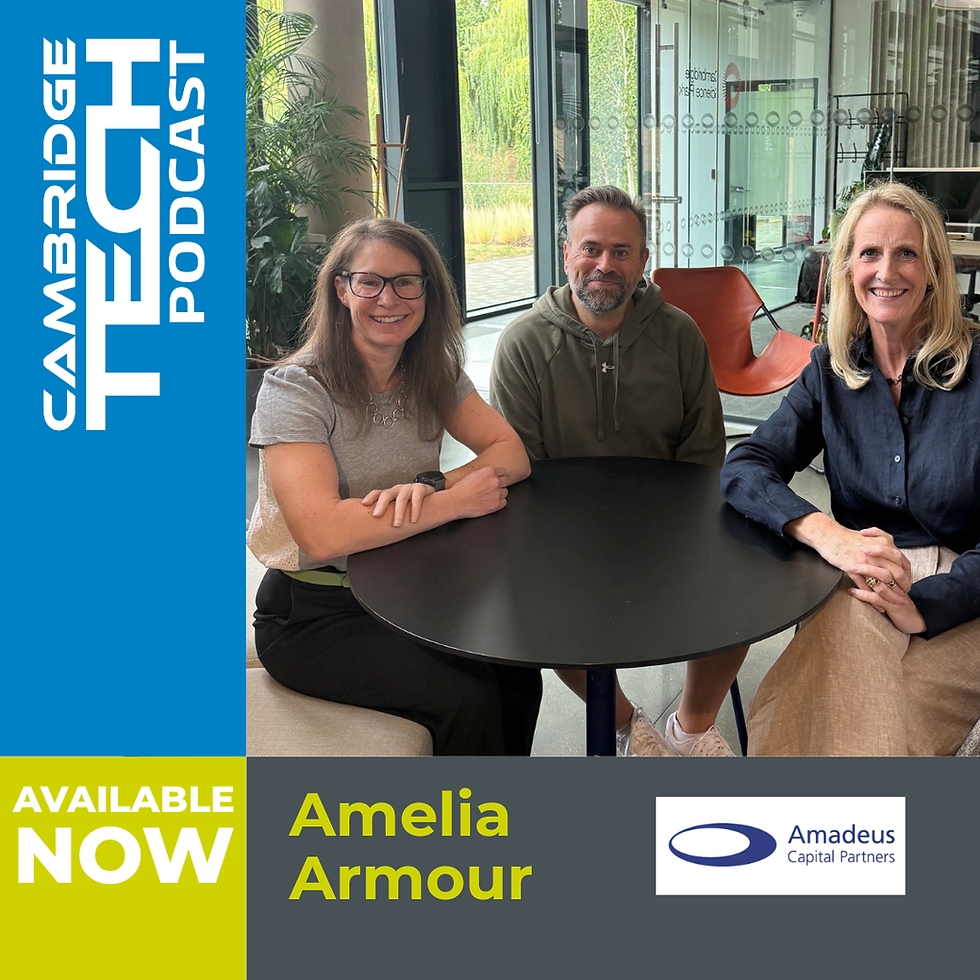
Show Notes 219: Cambridge Tech Week 2026: Where Ecosystems, Capital and Big Questions Converge
Cambridge Tech Week has firmly earned its place as a must-attend moment for the UK innovation community. In the latest Cambridge Tech Podcast, hosts Faye Holland and James Parton are joined by Cambridge Angels’ Emmi Nicholl to reflect on a packed week of founder conversations, investor insight and the big questions shaping the sector.
For startup founders, investors and ecosystem builders, the takeaway is clear: Cambridge is broadening its reach while doubling down on the relationships that turn ambitious ideas into scalable companies.
More than a familiar crowd
Tech Week retained its distinctive Cambridge energy: busy, organic and full of chance encounters. Yet this year felt more outward-looking. Alongside familiar faces were new connections across manufacturing, defence, security and international innovation ecosystems.
The conversation ranged from local collaboration to links with Oxford, Manchester, Finland, the US and Nigeria. As James puts it, the real value lies in creating the connective tissue that lets an ecosystem work.
“Ecosystems don’t happen without those kinds of people.”
Founder–investor connections with substance
Innovation Alley brought that principle to life. Cambridge Angels ran office hours where founders could sit down with experienced business builders and investors to tackle a specific challenge. One founder described the session as the most productive 25 minutes they had spent all year.
That practical, candid access matters—particularly when funding conversations are more demanding than they were a few years ago. Emmi's message is encouraging but direct: capital and appetite for strong innovation remain available; the threshold for investability is simply higher.
For founders: build relationships before you need them and be explicit about the question you want answered.
For bridge rounds: show precisely what the capital unlocks, the inflection point it reaches and how every pound will be deployed.
For investors: collaboration can extend sector expertise and create stronger co-investment opportunities.
“The bar for what gets funded has become a lot higher.”
Collaboration is becoming investable
The Cambridge–Manchester partnership offered tangible evidence of cross-cluster momentum, with four joint investments already spanning therapeutics, technology and life sciences. The lesson for founders is that regional networks are becoming increasingly connected, and a broader investor base may be closer than it appears.
AI remains a highly active, if frothy, investment category, while biotech continues to attract attention despite a more challenging funding environment. In both cases, the episode reinforces that execution, clarity and the right team remain decisive.
The dual-use debate moves centre stage
One of the week’s most compelling discussions examined the increasingly blurred boundary between civilian and military technology. The debate did not offer easy answers, but it made the need for active governance impossible to ignore.
“Democracy shouldn’t stand back, it should step in.”
For technologists, the challenge is not only what can be built, but what should be built, and how companies set ethical boundaries as dual-use applications emerge.
Listen to the full episode for the behind-the-scenes perspective on Cambridge Tech Week, sharper funding insight and the conversations founders and investors should be having next.
Subscribe to the Cambridge Tech Podcast to stay close to the people, ideas and opportunities moving the ecosystem forward.
Produced by Joe Donaghy of Cambridge TV. Supported by media partner Business Weekly.
Subscribe on all major podcast platforms or visit cambridgetechpodcast.com. 🎧
Episode Transcript
Welcome to the Cambridge Tech Podcast. Talking all things technology from the heart of the UK's tech capital. Here are your hosts, Faye Holland and James Parton.
I'm Faye. And I'm James. We have a guest today. We have Emi Nicol, Deal Sorcerer extraordinaire from Cambridge Angels.
Emi, hi, welcome. Thank you, lovely to be here. So we've brought Emi in because like James and myself, Emi has been in different parts of Cambridge Tech Week during the course of last week. And we wanted to give listeners a little bit of a summary. So let's just do quick highlights.
First of all, Emi, What did you think of Cambridge Tech Week overall?
I love Cambridge Tech Week. I think it's very in keeping with the Cambridge brand. It's slightly organic and busy and there's lots going on and yet you tend to see some of the same faces. Although I must say the nice thing is it's lovely to see some familiar people, but there were a lot of new people too, which was really encouraging.
Yeah, certainly. I think the Friday, and we'll come on and talk about a few of these things, the Friday fringe event with the Chamber of Commerce, I rocked up and I knew maybe 5% of people in the room. Now, that was very specifically manufacturing and defence and security. So it's a slightly broader sector than what we're necessarily used to. But it was great to meet new people. Although I do have to say one of the days, I think it was Tuesday afternoon, I went to hide somewhere for a little bit of peace. And Jamie Bignall messaged me and was like, where are you? I said, come and meet me outside. So we stood outside the Guildhall just having a little two people huddle. And then by the time we'd finished, we'd had Catherine Chapman had joined us and Andy Turpin had joined us and Anne de Bray. And we got this lovely little collective. It's like we'd got a separate little meeting going out there, which was very Cambridge-esque as well.
James, what about you? Top level. What did you think?
As Emi says, it's really established itself as, I guess, the priority week of the entire year for me now. Something that I put in the diary right at the beginning of the year. You know you're going to be completely booked out for five solid days, which is unusual. So it gives a real focus and a real sense of purpose around that week. So I guess that's a good indication that it's important.
Found its place and it's got real traction. And yeah, as you both said, it was busy everywhere I went, great conversations. And we'll come on to more specific things as we go through the week. But I really enjoy myself. We're always supportive, right? Because anything that's coming up that's showcasing Cambridge, we're always going to be supportive of it. But I know certainly in the early years, us and others were saying this is quite inward looking.
Do you think that's started to change?
I think so. I met some people from Serbia, far-flung places like London. It was amazing to meet lots of people.
You mean Cambridge South?
No, but really, I did meet some really interesting people from places that I didn't expect to meet people. But as I said, I think there is a comfort in having a community that you tend to know. So, you know, the example you gave, Faye, of ending up with a group of people around you. So it doesn't have that ruthless networking feeling that I think some conferences have, where you feel like you're being networked at rather than with.
Yeah, as you said, Faye, I think there was that kind of criticism in the early days that, and just generally speaking, that Cambridge was quite inward looking and quite hard to penetrate from the outside. But I think, as we've covered on the podcast over the last couple of years, there's a number of different initiatives now that have been spun up to address that. And that was really evident, I think, this week. There was also the work that Catherine's been doing, Innovate Cambridge. There was the Oxford to Cambridge Super Cluster. There's some Manchester partnership thing going on that I've heard about, but I'm not sure what it is. And there's also the ESPO connection into Finland with the connections between the two quantum clusters, which is interesting. Just a variety of different programs that are now really there to address that and to really open things up.
Yeah, and I think Monday kind of covered that really nicely. And so it looked at the UK specific, which obviously contained the local. So I sat on the panel, but actually we didn't really have a panel. We fireside chatted between ourselves with Catherine Chapman from Innovate Cambridge and Matt Allen from the Oxford Cambridge Supercluster. And had that conversation about how if you pull together in your own specific areas, you can achieve much more together. So we did it on a local basis and then it went international. And I think that was really interesting.
To hear from Vinnie Baranek from the US and we had Tokenbo Ismail who was talking from Nigeria. So actually understanding how their ecosystems work and where there are similarities and differences. And actually, amazingly, James, you were in the same session, so I might have an opinion.
It was the same. They have the same challenges. It's about connecting people. It's about telling stories and those kinds of things.
Yeah, I think you're right. I think sometimes service providers and ecosystem connectors get a bad rap, right? Because everyone's focused on the technology, the IP, the value creation. But it does bring home that without the kind of people working to bring people together, to create that glue, ecosystems don't happen without those kinds of people. So as you said, it's the same kinds of challenges. It's the same kinds of skill sets that are necessary in all these different clusters. One thing I would say, you're right, there were some folks from the US represented, but I felt like there could have been a larger US presence across the week. I think when you think about just how much capital, how much history of innovation and startup culture you get in the US, I think I for one feel we could maybe think about focusing a bit more in bringing some of those people. Those folks over to share experiences and build that connectivity. I don't know if that was a deliberate thing because it felt very UK focused and European focused, which might be an editorial decision when the conference speaker lineup was being put together. But that was just my only observation.
Yeah, I don't I genuinely don't know what the answer is to that. I know it was much more European this year.
Yeah, I'm pretty sure we could take that to Michaela and team and see they've got 12 months now. Give them maybe give them another week off and then we can start hitting them up with feedback for the next year. But if anyone actually is in one of the US ecosystems listening and would be interested, then definitely reach out to us as well. And that work is obviously happening. I think it was more just a comment in terms of getting them visibility at the conference. Because as an example, Cambridge Enterprise are taking their start cohorts to New York and San Francisco this month. There are those bridges. There are those conversations. I know Innovate Cambridge has spent a lot of time studying other ecosystems. So we know that work's happening.
Yeah, indeed. Maybe just to maybe surface that at the Tech Week.
Yep. Okay, so we'll write notes down as well, shall we? We'll take actions for other people during Cambridge Tech Podcast, which is always lovely.
Okay, so Tuesday and Wednesday was Innovation Alley. I was there on Tuesday.
Emma, you were there too as well, weren't you? What was your day like?
It was. Yeah, Tuesday was amazing. So we did office hours on Tuesday. Our angels give up some of their time just to sit and listen to founders, talk to founders. They're encouraged to come along with a specific question to the angels. But founders just really value the opportunity to just have a chat to a real business builder and investor.
One of the people who met with One Time Amazing Angels, Chris Mitchell, said it was the most productive 25 minutes he spent this year. It was just such a lovely accolade. So really, really gratifying and I'm very grateful to our angels for giving up their time and for the founders who willingly booked in time slots to come and see the Cambridge Angels. When we rocked up on site and we saw the corner that you were put in, because you've sat on the actual exhibition floor before, which must be way too intense for the angels to have those kinds of conversations. So they put you in a corner somewhere and we were like, oh, how is that going to work? But actually it worked really well, didn't it? Yeah. So, yeah, obviously it's important that you can actually hear the people that you're talking to. So I can understand why we were not in the main exhibition hall because it is incredibly loud in there in a nice, fuzzy way. But yeah, it was a bit like sitting outside the headmaster's office to come and have your appointment. But it was great. It worked very well. Excellent. And the halfway through, I got a journalist to come and talk to you, didn't I, and thrust a phone in your face. So that was nice, wasn't it? He was great. He was really fine. He was really interested in exploring why this ecosystem works so well together. So we dug into that. Yeah. And James, you were back like the old days, manning an exhibition stand, weren't you? I was, what's the word I'm looking for? Pinned in Innovation Alley for two days. So yeah, I didn't get to see too much else on the Tuesday and the Wednesday, but it was really good. Lots of conversations. It was nice also because we had a larger booth this year. We showcased three of our Trinity Bradfield Prize finalists. So One Carbon, Face Shift and Green Mixes were there with us, which was great to give them an opportunity to get some exposure. And yeah, just lots of conversations, some with folks that we knew and quite a few new people as well. Met the ex-CTO of Moonpig, which was an interesting conversation. Very good. Very good. Yeah, I think the zones worked really well this year, actually, because like you, you've done it in previous years anyway. You put some of the companies on. The Cambridge Manchester Partnership had taken a zone as well. So we had SilverA, Uflow, ColoriQuo, Vortex, Lanthogen, Bio and Sporesense on the stand as well. And it really, it just really adds that extra dimension. Burkitts did the same. HCR Law did the same. It wasn't about, in my instance, the partnership talking about itself. It was actually showcasing these really cool companies from Manchester as well. So I do think it went very well. But Oh, man, I think, sorry, Amy, I think I'm getting too old to stand on an exhibition floor for two days as well. Vegetable shoes are the number one requirement. I was going to say, Faye, the list of companies you just rattled off, it's an impressive list, really, that the collaboration between Cambridge and Manchester has been, it's gotten great guns. I think there's a lot to be said for that. And on Tuesday, we also did a bit of a fringe event, getting together some of our Cambridge Angels, West Manchester Angels, and a lovely support from MHSBC Innovation Banking. And had a fantastic conversation and just connected more people, which is really what it was all about.
Yeah, and that's how things happen, isn't it? When you've got groups that start to come together and have those frank conversations and your angels, whether it's Manchester or Cambridge or anywhere else, are at the cutting edge of these conversations. You can see things coming through. It's definitely super useful to be able to leverage that knowledge bank.
It is. And I think there's a lot of, you've identified this through the partnership as well. There's so many gaps that we can fill in each other's knowledge base and skills and expertise. And the way that we see that happening is through joint investments. So the more deals we can do together, the better. And we can really just make sure that we're taking advantage of what each city offers. And I thought there was only one recent joint investment. There are four joint investments, aren't there, between Cambridge and Manchester Angels already?
We already have four joint investments, really great companies. So we have Monument Therapeutics, we have SeoVision, Telerix and Molliman. Some really great companies covering quite a broad base of industries and expertise. Brilliant. So that gets us to the end of Tuesday. Wednesday is no secret my favourite day, which is Startup Scale-Up Day. Did either of you go to that?
There for the first 30 minutes or so so you made me stand up and then sit down so thank you for that hey you got a round of applause though right she made you stand up and sit down for 30 minutes james yes that's true in a strict timeline it went down so well i might as well do it just for people who weren't there i made every it's the start of a conference it's a dark hall And everyone sat down and I'm like, I'm not having that. We've got to get some energy going. So I did make everyone stand up. And then anyone that was works in the ecosystem, the lawyers, the networks, the people with space, the storytellers, everyone who supports the tech innovators had to sit down first of all. And everyone who was standing up, which was basically the investors and the founders and the corporates. Had to give everyone who'd sat down a round of applause because without everyone who'd sat down, nothing would happen. And then eventually I ended up letting other people sit down. So it was just a little bit of fun to get things started, basically. It was a really good day.
I mean, James, back to your earlier comment, the speakers there were absolutely fantastic. We did have... Investors there, local. So Owen Thompson did a great job, but so was Saranga was there. We had Irene Graham from the Scale-Up Institute. I'm trying to think who else we had now. Joanne Hosker came from Northern Gritstone, Tom Adeolu from Innovate UK. So we had a really strong mix of people speaking. Debbie Toms, who's been on the podcast, did a 15-minute keynote and it was brilliant. Did you see that one, James, or not? Or did you hear about it?
I was really upset I missed that because she's absolutely brilliant, isn't she? But I loved the episode we did with her on the podcast. You missed a great one, James. She basically stood there, completely owned it and said, look, this session is going to be, I'm just going to tell you all the questions that we get asked and I'm going to give you the answer. Some of her answers were like, hire a lawyer. A good lawyer, an expensive lawyer, because it's really important that you do that. Make sure that you build relationships before you go and ask people for things. Really tangible examples, even write down, and she talked about it on the podcast, which is get on WhatsApp, because when the investor wants to send you a term sheet, you want to get that really quickly. And so WhatsApp, so just really simple, real tips. So yeah, she was absolutely brilliant. So it was a great day. We had the pitch competition. Emmett, you were one of our esteemed judges. How did you find the pitching competition this year?
I think it's great. The real work, of course, went into selecting those five finalists and good job to them because it was a great set of companies. I thought it was very interesting. I was fascinated by the fact that three of the companies actually, in fact, was it four of the companies brought along a proper kind of tangible thing to show the audience. And I think that went down really well. I think the audience and, of course, the judges really like to see a thing where it's possible to. Yeah, we didn't let them use slides, did we? So they had three minutes to present. So I think that the prop definitely helps. And it was commented on by the judges.
So there was yourself, there was Zicky Lim as lead judge, Richard Lewis from Foresight and Marilena Aonidou as well. All of you commented on it was good to have the prop. So if you're listening in as a founder and you're doing a pitching competition, not everyone can take a prop, obviously. But if you can, it seems to be quite a good thing. Hang on a second. So we obviously did the preview episode with them back in August, didn't we? So I know who was participating, but I've done that kind of avoid looking at the football scores thing. So I don't actually know who won.
Are you going to give us an update on who scooped the prize?
Emmy, do you want to do that as one of our esteemed judges?
Oh, I can. I can pretend I'm actually presenting them with their award. Interesting, really, that the People's Choice Award and the Judges Award were different companies, which I think is a good thing. I think that's a wonderful, wonderful accolade for both companies. So the People's Choice Award went to Landa, which is an amazing agri-tech company, and our Judges Award went to Myonerve for stroke rehabilitation.
Excellent. Congratulations to them.
Yeah, indeed. I think everyone was pretty ruined by the end of Wednesday in the nicest possible way, of course. There was a Business Weekly award dinner that night as well. So that was a very big evening. A few of our people that we know from the podcast won. So Pragmatic had won again. Shiraz Anansur won Technology Entrepreneur and Mahanthan Talai won won Life Science Entrepreneur. So I was really pleased with that because they've been on the podcast here, huge supporters, and they're out there winning prizes. And Cyclana Bio won the Innovate Cambridge New Torchbearers Award as well. So that was a good night, very long night. It has to be said, I think I was back at my my my home place at about one o'clock in the morning so that was perfect ready for a thursday breakfast meeting so i think thursday was fringe events we had the main tech deep dives and i james you popped into one of them didn't you and then i think it was all everyone was holding out for the big tech debate which was on defense so it was really good to have defense on the agenda this time Yeah, I'd love to hear how that went, because referencing back to those conversations I was having on the Tuesday and Wednesday, defence was cropping up all the time. I'm not surprised to hear that one was packed out. They did the first little bit of their pitch for the for and the against. So we had Lily Chan and Shane Mason that were for and Adam Smith and Andy Bailey who were against. And when you pulled the room at the start, it was majority against, then undecided, then for in that order. And actually, the important bit of what I'm about to say is the demographic was quite diverse in the audience as well. So you can think in your mind that people will be voting a certain way. Incidentally, the motion was this house believes that democracies should embrace the erosion of the boundary between civilian and military tech. So that was what the motion was. By the end of it, there were far fewer undecided and the for camp was the one that had grown, not the against. So I would say it probably ended up, it was pretty much a fair split between for and against. So more people were convinced for than against, which was interesting. But it was things like democracy shouldn't stand back, it should step in. So there were quite a few very strong anchors in the forecase that I think helped. Although Adam Smith did say that we should all, and certainly technologists, should be asking the questions of what won't you build and how are you going to drive regulation? But I think that's pretty standard in the majority of tech companies that we'd see anyway. Do you see like a blurring of the lines in the sense of traditionally, if you're a company working in the defense sector, that was very clear, right? You're manufacturing something and that's your core focus. With this kind of move towards dual use, you might invent something that wasn't intended to be used for defence, but becomes an almost accidental product line with the changing of how the Ministry of Defence procures. Was that talked about? How a company would wear both of those hats simultaneously without any knock-on effects to its consumer-facing side versus its defence-facing side?
It's an interesting challenge from a PR perspective. It is, and I think it was Adam that gave an example of Pokemon Go. Everyone went out with that. I don't really understand it because I didn't do it, but went out with a phone and went all around different places. All of that data got sold to a defence company. So everyone who was doing Pokemon Go did not sign up for that to happen. I mean, there must have been a small print somewhere saying, we'll do what we like with your data. And that's the point of it. The boundary is eroding. The motion was the little bit provocative. Should you embrace it?
I don't think anyone should embrace the erosion of boundaries. But you've got, you had Innovation Alley, you had InnoCity, HMGCC, who were actually specifically calling out for tech companies to help with specific problems and saying, look, you're developing a tech for this. Can we use it for a different application? And let's face it, it depends, GPS, things like that. It's civilian innovation that's got military roots and vice versa. Military innovation can have civilian benefits. And that was Shane Mason's argument. This is reality. We've now just got to be really careful what we do with it. The companies that are being approached by HNGCC are given that choice as to whether they want to engage in that kind of development. I think, James, you were alluding to companies who inadvertently end up being in that market. One is a very deliberate decision and the other is perhaps a decision that you need to make after the fact. It's an interesting one.
Yeah, it certainly was. And actually, on the Friday morning, the Chamber of Commerce ran a Defence Manufacturing and Security Summit. I mentioned that earlier on. And that conversation carried on there. I don't think that we all we have the answers, but at least we're having the discussion. And hopefully we're having the discussion early enough to be able to get regulation and governance and things like that in place. I think that kind of takes us to the end of the week, doesn't it really? So I think overall, it was really good. I think the general consensus was positive. We had more international content in there. I think there were a couple of things that did come up, which I don't know if we want to be a little bit controversial. It'd be great to get Emmy's perspective on this, is around funding. There just seems to be this constant dialogue now about founders not being able to get funding. But then you're listening to the people speaking on Wednesday and they're like, there is money available. So is it a question that we're not telling funders what they should be doing or we're not? It's like, are they not getting funding for a reason, i.e. There is no capital or their product's not good enough? What's your thought on that? And did you hear something similar?
I don't believe that there's a lack of capital. Capital is out there. And certainly from our angel's point of view, the willingness to look at new innovation is very much there. So the appetite for seeing great companies, that hasn't diminished at all. I do think that the bar for what gets funded has become a lot higher. So some of the edge places that may be in the crazy days of 2021 would have got funded just because they're interesting and cool. I think that bar is a lot higher now. I am also seeing a number of bridge rounds. So I think that the next stage, we know this to be true, that the scaling stage of funding is really challenging. So we're seeing a lot of companies coming along for bridge rounds to try and get them to that next stage of funding. That's really difficult. Bridge rounds are not easy, especially if you're approaching new investors. If companies are doing bridge rounds, they have to be crystal clear on what that's going to get them, where that inflection point is, and exactly how that money is going to be spent to see them through to the next stage.
Yeah, that's really good advice. Are you seeing any themes, Emmy, in terms of where money is flowing?
Obviously, AI has been a very popular area over the last couple of years. Is that still the case? Are you seeing anything else coming through in parallel to that?
That AI boom is still very much there. It's quite frothy. It's very hyped. It's not an easy space for angel investors because largely some of the big VCs will hedge their bets. They will invest in lots of things. One from every area. Angels tend to be more discerning in backing a particular winner team and an execution player they believe will work. So it's still very much an AI play. We're still seeing lots of biotech. And I know that there has been a lot of comment around biotech funding being really difficult. And I think that's true, but we're still seeing a lot in that space. It does tend to come in waves, but certainly AI and biotech are the two main things that I'm seeing at the moment.
Interesting. Super. I hope you've all enjoyed that episode. A little bit of a look into Cambridge Tech Week for you all. And Amy, thank you so much for joining us again. We're glad to have been here. Thank you.
Excellent. Join us next week where we meet the Internet Watch Foundation. Today's show was produced by Joe Donaghy of Cambridge TV and supported by our media partner, Business Weekly. The Cambridge Tech Podcast is available on all major podcast platforms and on cambridgetechpodcast.com. If you've enjoyed this podcast, please give it a five-star review. It'll really help others discover the show.
Technology moves fast, and now so can you. Discover Polestar, the all-electric performance brand vehicles redefining how we drive. Precision engineering, minimalist design, and software that evolves with you. Experience it at Holden Group in Norwich and Bury St Edmunds. Or let us bring the test drive to your door.
Proud sponsors of the Cambridge Tech Podcast. Polestar, electric performance redefined. Discover at holdengroup.co.uk slash polestar.

To listen and subscribe, search for ‘Cambridge Tech Podcast’ on your favourite podcasting platform or visit cambridgetechpodcast.com.