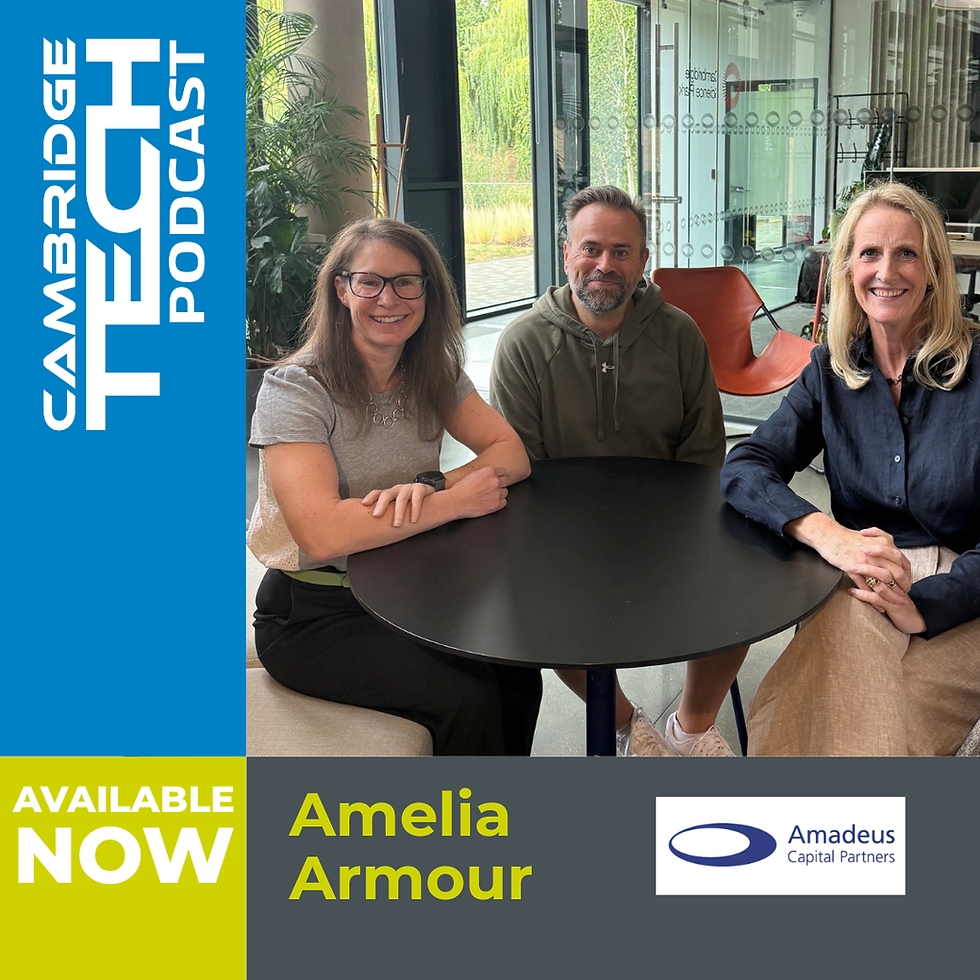
Show Notes 188: Bill Yost's full circle journey with Reclinker
Cambridge Tech Podcast is back covering leadership changes in the local deep tech scene to a fascinating deep dive into circular economy innovation. If you're a founder, investor, or just curious about what's happening in Cambridge's thriving tech ecosystem, this one's well worth your time.
Bill Yost on Cement, Startups, and the Transatlantic Divide
Hosts Faye Holland and James Parton sit down with Bill Yost, CEO of Reclinker, a Cambridge-based startup tackling one of the world's most polluting industries.
The Problem (and It's Massive)
Cement is the second most used material on Earth with 4 billion tonnes produced annually, and conventional cement production accounts for 7% of global CO2 emissions. If the cement industry were a country, it would rank behind only the US and China in carbon output. That's the scale of the opportunity.
The Solution: Clever Chemistry + Smart Partnerships
Reclinker's innovation is elegantly simple: convert reclaimed cement into clinker using electric arc furnaces already used in steel recycling. Rather than building expensive new infrastructure, they're partnering with existing steel manufacturers. As Bill explains:
"With that capital efficiency and scaling, steel makers get a number of advantages... economics that close the deals."
The material sourcing is equally clever—they're targeting large infrastructure demolition waste that would otherwise end up in landfill.
Key Milestones Achieved (So Far)
✅ Seed round: £2.25m (June 2024)
✅ Demonstrated process at industrial scale
✅ Secured supply chain agreements
✅ First customer (Sembland) signed offtake agreement
🎯 Series A targets: full volume production, product certification, trials with additional furnaces
The Transatlantic Founder Perspective
What makes this episode particularly valuable is Bill's candid comparison of startup culture on both sides of the Atlantic. The differences are stark:
In the US:
Investors expect IPO ambitions and "changing the world" rhetoric
VCs put up walls—you need insider access
Higher valuations but potentially unrealistic expectations
In the UK:
98% of pitch decks target trade sales at £50-70m
Warmer, more responsive investor culture
More collaborative ecosystem but sometimes lacking ambition
"The UK I think is absolutely the wrong size because it's so easy for a UK company to go, 'I'm going to start in the UK'... But I think it's a challenge to UK companies to start thinking internationally from day one."
Why You Should Listen
Whether you're fascinated by climate tech, curious about fundraising strategy, or interested in how to build in Cambridge's ecosystem, this episode delivers real insights from someone who's done it multiple times, on both continents.
Plus, there's a job opportunity if you're an entry-level lab technician with cement experience, Bill's actively hiring.
The Cambridge Tech Podcast is available on all major platforms. Give it a five-star review to help others discover it.
AI Generated Transcript
00:00JamesNow you can get directly involved with the show. Leave us up to 60 seconds of audio by visiting CambridgeTechPodcast.com on your computer or phone and click Call the show from the menu. Send us your news items, events to promote, leave us feedback or suggest a guest. Welcome to the Cambridge Tech Podcast, talking all things technology from the heart of the UK's tech capital. Here are your hosts, Faye Holland and James Parton.
00:45FayeI'm Faye.
00:46JamesAnd I'm James. So welcome back, Faye.
00:49FayeThank you and thank you for covering for me as well. I won't bore listeners with my tedious story, but I missed you all. But I'm back. Last week was back to normal for me. Really good week. Roll our sleeves up and doing lots of work on the partnership again. I think the main highlight for me was the Discovery Roundtable on Quantum, which was super interesting and I can't wait until we can start sharing some of those things and then you'll like this one. I was actually the guest speaker at a cam entrepreneurs event and I have to say, although Gary Packham interviewed me brilliantly, I much prefer asking the questions than being the subject of the questions. And then of course were recording the podcast, weren't we? So we had the chat that we are going to go through with Bill in a moment.
01:38FayeWe had a fintech session with Tim at Techiast and Anthony of iDenfo and then what a chat with Debbie Thoms on Cusp AI. I literally cannot wait for that one to be released at the end of the month.
01:51JamesFantastic. I mean, yeah, as you just covered lots of podcast stuff this past week, didn't get out to any events, so just really head down and grinding. We had the debut Claude Code meetup at the Bradfield which was a complete sellout. So congrats to the organizer Ashwini. Just shows the kind of interest levels in AI. No surprise there. I've only made one mention of this, I think in previous news sections, but I've been working away on a project behind the scenes and we're going to be launching that at the CW International Conference at the end of the month. So I'll share more on that when I can. Just looking forward to next week actually because even though I was head down this week, I've got lots of catch ups with people planned next week so I can update you all on that next episode.
02:34FayeNice. And you can't give us another teaser? That's like you've had three teasers now. So we need the meat at the end of the month, please.
02:42JamesYou teased your new job. You cannot tell me I can't tease anything.
02:46FayeOkay, yeah. Detail, detail. Should we move on with the news rather than arguing? We've just got a couple of people changes actually. These have come up in the last week or so that I think are worth covering. So first up, deep tech powerhouse Cambridge Consultants announced that Richard Trehearne is the new Chief Executive after Monte Barlow joined the parent company Capgemini Invent as their Chief Technology and Innovation Officer. So congratulations to both of them in their new roles.
03:15JamesAnd Cambridge engineering AI pioneer Monymo has promoted former CTO Dr. Jarek Razi Packi to the CEO role in place of co founder and business inspiration Dominic Vagine. Monymo chair Martin Frost praised Dominik for his leadership since the company's inception and it'll be interesting to see where he appears next.
03:34FayeAbsolutely. So now let's head to our discussion with Bill Yost, CEO of RE Clinker, for a lesson in all things cement, as well as some really interesting insights on the differences that Bill has experienced in both the areas of funding and working on either side of the Atlantic.
03:59JamesBill, welcome to Cambridge Tech Podcast.
04:00BillPleased to be here. Good to see you in person.
04:02JamesFantastic. We always like to start with getting to know a little bit about you. You've got a really interesting and varied, certainly professional background, but let's go all the way back. Pittsburgh, usa I believe that's my hometown.
04:13BillYes, it's. For those who don't know, it's pretty firmly in the rust belt in the American Northe. It was a steel town, probably similar to Sheffield I suppose here in the uk. Yeah, I grew up as the son and grandson of builders. My dad and granddad were bricklayers and worked in concrete. So I grew up mixing mortar and wheeling concrete. Hated every minute of it. Worked in a cement kiln and a concrete ready mix plant while I was at university and couldn't get away fast enough. So I got my degree and left. But fast forward 30 plus years and I'm working for a cement startup in Cambridge. When I called my dad and told him what I was doing, he dropped the phone and laughed. Said, I knew you'd be back.
04:54JamesWe're definitely going to come back and talk about the insights you've got from spending a large chunk of your professional career working in the US and the uk. But tell us how you first came over to the UK.
05:04BillYeah, this is my third time living in Cambridge in 30 years. I came over as a student for a year in an exchange program and met the woman who's now my wife, which has, I think, been the draw to coming back the other two times. I finished my degree in the US and worked for a while and then looking for personal reasons to come over, the stars aligned and I was offered a job here in the Cambridge Science park in 2001 for a startup that claimed they had just closed their Series B. I was coming on as a sales and marketing manager and six weeks in it turned out that deal hadn't actually gone through. So the company went from 35 people to 17 overnight.
05:41BillLuckily I survived that and my visa, I wasn't a citizen at the time, was job specific, so if the company had gone under, it would have bankrupted me. I just signed a lease, I moved all my things over. So I hadn't intended to learn how to raise venture capital. But real trial by fire, we ended up completing a 6 million pound Series B for the company in February of 2002, which led me to want to learn more about finance. I'd always have a technical background, realized that money sort of trumps lots of other things. So moved to London and did a degree, but moved back to the States for 10 years and came back here in 2016. So I think this time for good, for obvious reasons, I think.
06:18FayeAnd when you came back, that was when you started Inventure?
06:21BillI did a couple years in consulting for BA Consulting and was recruited by Mercia Asset Management to work in their hardware investment team, which was great early stage and regional funding. So they tend to avoid the golden triangle, which really expanded my understanding and exposure to the north and the Southwest. I got to travel lots to the Midlands and Manchester and yeah, that was a great grounding for then moving to Foresight, where I continued to invest in early stage companies, but had connections more broadly across the UK than simply Cambridge, Oxford and London.
06:53FayeYeah, and I think that was when we first met, when you were in foresight, wasn't it? So tell us a little bit about those journeys you had. You had to raise the funding for the first company on the science park that you worked for and then you went into funding. What are some of those experiences? What did you learn? Learn from that?
07:10JamesYeah.
07:11BillI mean, so much and well, I should say that while I was in the US for the 10 years between working in the Science park and coming back, I had the good fortune to be able to spin a company out from De Beers, where I was working at the time, and then to do another startup as spin out from mit as co founder and CEO of both instances. I'M embarrassed at how naive I was about raising Venture the first two times as founder and CEO. Having been an investor, I'm finding it a lot easier to understand the process and I hope I'm a better CEO because of it. Very naively, I assumed that a VC was someone who had access to cash and if they liked the story you were telling, they could write a check.
07:51BillI hadn't appreciated the kind of the process that takes place within a VC firm and that effectively, when you do connect with someone in Venture who likes the story, they in effect become your champion and start to pitch internally to their team and they have to build an investment case and write papers. And quite a protracted process does take months. And to be able to give them the right information at the right time to avoid any surprises and to appreciate that they're on a journey on your behalf, I think has made me, I think hope has made me a better CEO.
08:24FayeSo I know we're going to do this slightly the wrong way round because I would like to carry on the funding conversation before we actually get into the detail of what Reclinker is and what. What you're doing. So what was then your experience, having come out of Foresight, find yourself in re Clinker and then realize that you're starting to raise again. What was that experience like and how did it work for you?
08:45BillYeah, so there was a little bit of an air gap. I left Foresight to do a portfolio of my own things. So I was chairing a carbon fiber recycling company in Bristol. I was an advisor to old college capital in Edinburgh, having a lot of fun, dabbling with lots of things, and I would have been very happy to carry on doing that. But I think everybody probably listening in the room knows Paul Bailey. He's quite a figure here in Cambridge. He and I were having a chat and he said, look, something about cement. Yeah, not that's ever been in my career. And he said, look, there's this really great startup that's been incubating in the university engineering department for a few years.
09:20BillThey've got some innovate funding that they've used to really progress the technology, but there's no commercial team and they're at the point where they need one. So he made the introduction. I met the three academic founders who were really impressive and really great people, and we hit it off. And the other piece of the puzzle was at the same time, one of the graduates from that department, Poppy, our COO now, had gone off to work in supply chains for 10 years at Accenture, and she was keen to jump in. So the two of us had a really complimentary set of skills and we. We put our hats in the ring to say, we'll write the business plan and when we raise money, we'll come on and start to get paid. So it was six months of fundraising on the basis of hope.
10:01BillWe closed our seed round in June of 2024, so two and a quarter million pounds to get us started.
10:09FayeGreat. And so now where are you up to? And also, can you share what some of those triggers were to know that you're ready for the next rounds?
10:19BillGreat question. And another experience from having been an investor is every time I took a proposition to the investment committee, there is always this demand, what are the milestones? How are we going to know that the company's done what they said they're going to do, that they have to be measurable, they have to be very clear, they have to be just a handful. Right. It's not 25 milestones. So that was something were very keen to communicate in our seed race, was we have three milestones, these are what we're going to do and as of now, we've hit them, I'm very pleased to say. And that's given us a lot of credibility as we go out to raise a Series A, to say, this was the deck that we pitched, this is what we said were going to do, here's where we are.
10:57BillBut I think a slight error that I made in raising our Series A is that the. There's a bit of a headwind in raising these days, even in the climate tech circles, and we thought it'd be really good to get out ahead of that and raise earlier. So we started fundraising in January of last year and weren't really far enough along on those metrics, so we got a lot of interesting conversations. We did get a few doors closed. You know, you're not ready. Some of the better funds said, look, we'll keep an eye on you're not ready. But. And it really wasn't until August of last year where we could demonstrate, we say, we've got that agreement in place, we've produced this material, we've done this, that was the trigger. I think that were Series A worthy.
11:37BillSo I think advice, if there is anything in there, is to set milestones, but also be mindful of where you are in achieving them and use that as your guidepost for are you ready for the next round?
11:49JamesPerfect. I mean, as Faye said, we've slightly Done this back to front, but let's go back and explain to the audience exactly what reclinker does. So tell us about the company and what gap in the market did you spot?
12:00BillWell, it's a huge market, so we're in cement. Cement is the second most used material in the world behind water. So 4 billion tonnes produced every year at a value of about $400 billion. So it's massive. Unfortunately, conventional cement production accounts for about 7% of global CO2 emissions. So if the cement industry were a country, it would behind only the US and China as in terms of carbon emissions. So there. And there's massive pressure for the cement industry to decarbonize. So there are various approaches to trying to do that. Our clever CTO Cyril, worked out that actually you could take used cement and if you exposed it to the right conditions, you could turn it back into clinker, which is what comes out of a cement kiln. So clinker is the precursor to cement.
12:44BillYou grind it up and add some gypsum and that's what we would recognize as cement. So Cyril's innovation was recognizing that, but he needed to find an industrial scale source of high temperature process that was ideally electrically driven so that you could kind of account could reduce the carbon emissions associated with the power. And it turns out that the electric arc furnaces used for recycling steel are ideal. And steel makers already use lime as a flux to clean the steel, to protect it from oxygen, to kind of add a thermal barrier to protect it.
13:17BillAnd we've demonstrated that if you replace some or all of the lime with cement, it does a really great job as a flux, it does all those things that the steel makers need, but instead of turning into a low value slag, it turns into a high value co product of clinker. So we've been very lucky on many fronts. As I mentioned, when I met the academic team, they were already operating under an Innovate UK program with six and a half million pounds that had representatives from across the circular supply chain. And that's a credit to our other co founder, Pippa Horton, who's just a person who's able to bring people together and make things happen.
13:52BillSo she got BAL for Beatty and Atkins and Tarmac and seven Steel and the Materials Processing Institute all kind of aligned and they took the technology from TRL2 to TRL SEP and that's when I got involved. So it was a. Yeah, it's been a really interesting journey. We're very lucky to have had the partners. We've had seven steel who. The steel industry is big and slow to change. So to have a partner who's willing to innovate, albeit very incrementally, has been a great benefit for us.
14:21JamesSo the strategy of partnering with steel manufacturers, I guess the main benefit there for you is you don't have that capital need of building infrastructure, which is obviously a massive advantage. What's the incentive for the steel manufacturers to use reclinker?
14:35BillYeah, so on the first point, it is a massive advantage to us. I mean, as an investor I looked at a lot of climate tech propositions that could have had impact or could have impact, but are almost unfundable because of the capital intensity of scaling up. I mean, hundreds of millions or billions of pounds in some cases. And that's what really attracted me to the reclinker proposition. With that capital efficiency and scaling, steel makers get a number of advantages. We don't expect them to do it for free. In my previous life as a founder of a clean tech company, I learned that it's really easy to have conversations when you're talking about something clean and low carbon, but it's economics that close the steels. And so we had to be mindful that steel maker has to get some economic benefit.
15:15BillLuckily, the kind of, the split of margins is sufficient to make that interesting to them. Steel is a very low margin business, so it doesn't take a lot to move the needle for them. But there's some other benefits. There's a carbon benefit, there's some general esg, you know, benefits. And also we've brought in like kind of a sense of innovation because steel is quite lean. There aren't a lot of innovation projects and we're bolting a process on top of their existing process and we're highly incentivized to analyze what's coming in and going out to a level that isn't needed in steel, but still has given us some insights. So we've been able to share process insights with our partners.
15:56BillAnd yeah, I think they've, so far they've been brilliant to work with and they've even offered to be a center of excellence to help to promote the technology throughout the steel industry and ride that sort of wave of being the first mover and the kudos from being an innovator in the space.
16:12JamesAnd if we look at the start of the supply chain, where's the sources of the reused concrete and how do you protect that supply?
16:22BillYeah, so we get asked that question a lot and there's a lot of demolition waste. But not all demolition waste is the same. So residential demolition waste is not great for us. It's full of brick and wood. We like the really juicy infrastructure, the concrete, Big, massive concrete structures. So roadways, bridges, water treatment facilities, those sorts of things. An interesting parallel with steel is that when concrete structures are torn down, one of the first things that's taken out are the steel reinforcements, the rebar mesh, and they tend to go to Cardiff for recycling where they make more rebar. And so 7 steel. Have a view of where some of these definition projects are going to be, and we can kind of ride on their coattails to connect to the concrete that's coming out of those. But we found quite a few sources of material.
17:11BillBecause the furnace is in Carta, we want to source the material as close as possible to that because you don't want to transport large, heavy material. So we source demolition waste. The processors of that waste already break it down and separate out the sand and gravel and they can sell that on for reuse. What they're left with is the fine powder that's rich in cement, and that's what we're interested in. Historically, that's gone to landfill, and that's been a problem for those demolition processors. We're asking them to kind of change the process to make it a little higher grade and then we'll pay them for it. There is some competition for that material. It can be used to go straight back into concrete mixes as a filler. So it doesn't have. You can't use it to the same proportions as new cement.
17:53BillThere is a use for it. We can pay a higher price because we're turning it into a higher value end product. So the market around recovered cement paste is evolving, but we think we've got a sustainable economic proposition. And as other people become interested in recovered cement, it's actually better for us. There'll just be more of it around and the best practices will promulgate.
18:13FayeI think what you're demonstrating there is that circularity, which I think is really important and probably a big differentiator. Is that correct?
18:22BillIt is. We found when we've talked to the stakeholders across the cement supply chain, from cement companies to the specifiers of projects, the insurers, we've boiled down what we think the market is really looking for. They're looking for a low carbon product. For all the pressures that everyone's under for reducing carbon, they're looking for something that is cost competitive again. People have conversations with you if you've got something Green. We believe there are some pockets where there's a green premium of 10 or 15% but doesn't apply universally. Something that has to act like conventional cement. There's a 200 year history of using cement. The processes and ancillary materials have all been defined for a very long time. And changing any of that is really, you know, a headwind. We can address those.
19:07BillThe circularity right now is probably the least important of the four, but we think that's gaining in importance. And places like London are beginning to mandate minimum recycled content in new builds. And I think that's going to continue and will drive emphasis on circular materials in the built environment.
19:25FayeBecause I think that's. You're starting to see lots of the big development opportunities now. They're having to report on circularity, aren't they? So it's coming and you're hopefully a little bit ahead of that.
19:36BillYeah, and there's a kind of, there's some really interesting examples that are very specific to infrastructure projects. One company that we've been working with historically is Balfour Beatty. They've won the bid to do the Lower Thames Crossing and that'll be a multi year, multi billion pound project. In building it, they will use concrete in temporary works, so their own roads and pads for their command centers, et cetera. The public aren't exposed to those materials, so the kind of certification threshold for them is a bit lower. Plus they're only in place for two to three years, but they still count as part of the carbon footprint of the project.
20:10BillSo the idea that you could use a low carbon cement even before we're fully certified and then tear it up and send it off for recycling gives it a double carbon benefit in some ways and it tells a very good story in a materially managed way.
20:24FayeSo what do you need then to be able to scale? You've just said you've got to wait to be certified. There's obviously some steps that you've still got to go through. What is going to be that tipping point for you?
20:35BillWe're almost there. We, and I say we, Poppy RCO has done an extraordinary amount of work lining up the supply chain for the covered cement paste. And now we've got thousands of tons in the queue, which is brilliant. And we can see a path to a steady supply of that. The access to the arc furnace. We've got an agreement with our steel partner for pilot scale and an agreement to negotiate a full scale commercial ramp up, which we're very pleased with. Downstream. There's a little bit of a bottleneck in processing the material. So grinding is not very economical in small volumes and really the economies of scale kick in at very large volumes. So we're going to have to manage that. And I think that's a problem specific to us.
21:18BillBut there's a general kind of startup somewhere in your supply chain, somewhere in your process, there's going to be something that isn't going to be optimal until you hit some scale. And so we're dealing with that problem. Investment. The Series A is going to help with that a lot, customer wise. I've worked in a lot of industries and I've had to do a lot of customer education, breaking into new markets. This is the first time I've ever sold a commodity and it's much easier. Everyone knows what cement is. The customers know what the specifications look like. So if you can perform to this standard and if it costs that much, if your carbon footprint is X, send us a truckload. We do need the certifications and that's an evolving space in itself. In Europe, the cement standards are almost entirely composition based.
22:06BillSo if you have these compounds in your material, you are defined as cement and you may progress to full certification. The US is much more performance based, so it doesn't really matter what it's made of, but if you have this strength in these conditions for this period of time, fine. The UK has taken one step towards performance based, so they've introduced what's called the Flex 350 standard. Otherwise it's all under the European EN197 compositional based standards. So we're kind of a beneficiary of that kind of trial here. And indeed our early material we will be seeking to certify under the Flex standards, but our intention is long term to have the composition that we can achieve the full en197, which we think is a competitive advantage. It gives us that kind of universal. Wherever you buy cement, you can buy ours too.
22:54BillIt'll take a little while to get there.
22:56JamesAnd just a final question on the product side of things, just so I got that complete understanding. Once the product's been through that furnace process and you've got the. You go through the grinding, is it like a one for one replacement of traditional cement or is there a kind of a blend with traditional cement and reclinker, how does that actually work?
23:14BillYeah, that's evolving as well. So our initial product is not fully seminar and there's some reasons for that to do with the particular furnace in Cardiff we see a path to that, changing the material that we've produced on the pilot scale. There's a furnace in Middlesbrough that was part of the Innovate program at the Materials Processing Institute. We did produce material that according to standards, would meet the definition of Portland cement. We haven't achieved that yet in Cardiff. So in the interim, the material we have produced has been shown to work well in blends, so it displaces a proportion of blast furnace slags. So backing up a little bit, we're working with arc furnaces, which are primarily used to recycle steel. The other way to make steel and effectively virgin steel is blast furnaces.
23:58BillThey're highly emissive and they're slowly being replaced by arc furnaces. So you only have to look at the news in the UK to see Tata shut down a blast furnace in Port Talbot, which is in fact being replaced by a massive electric arc furnace. Arc furnaces today account for about a third of steel making capacity and it projected to be over 50% by 2050. So there's a great trend there. But blast furnace slags have been used in cement mixes for decades and they're really good. Electric arc furnace lags traditionally don't have the same reactivity, so have been designated for things like asphalt and fill. So very low value. So we're riding this trend of diminishing supply of blast furnace lag and increasing capacity of arc furnaces.
24:40BillAs we work with the arc furnace, the material that we have today can displace some of the blast furnace lags. And the UK is currently importing blast furnace lag. And it displaces a bit of cement, so it's got a ternary blend cement blast furnace laginar material. And once we get to the composition that meets Portland cement in the arc furnace, we expect to certify that fully as Portland cement, which would be 100% replaceable or could do 100% replacement of conventional cements. So it's a journey, but I think it says something about the appetite for low carbon materials that we've had a really willing set of partners working with the materials. And I should mention specifically, Sembland is our first customer. They've given us an offtake agreement for our material of, you know, hundreds of tons.
25:23BillAnd they have a history of blending cement with other low carbon supplements. So fly ash and blast furnace slags. Okay.
25:31JamesAnd so once you've perfected the process and the science is the key to scaling, just parallel running the relationships with a number of arc furnaces internationally yeah,.
25:41BillAnd that's the exciting part. And you're touching on the milestones for our Series A. So from stepping back, from an investor perspective, talking to any startup, you really, you want to see that sort of value creation story and the milestones should be tagged to that value creation. So in our seed round we said we would demonstrate the process worked industrial scale furnace, that we would have a channel to market for the material we produced and we'd have the supply agreements in place with the supply chain to move into production. So those are the three boxes we ticked. The milestones for our Series A are to get into full volume production at our first furnace, to have certified product as broadly as possible in the uk, and to be at the point of trials or pilot production with at least one other furnace.
26:25BillAnd those all unlock value. So the idea is sure that we can do it, sure that we can replicate it, and then when we look forward to Series B and beyond, it's just iterating n times and that iteration is setting up that same supply around different arc furnaces. And to put it in context, the furnace in Cardiff produces a million tons of steel a year. That's a mid sized EAF. On the back of that we can produce about 120,000 tons of our material with a market value of something between 15 and 20 million pounds. So if we can bring one more furnace of a similar size on, we double that.
26:56BillIf we bring on a furnace of 2 million ton capacity or 3 million capacity, we're really pushing towards half a million tons of production a year and 50 or 60 million pounds of market value. So that's a really steep hockey stick type curve. We've got the fundamentals, I think, that support that kind of view.
27:15JamesYeah, that's fascinating. And so we mentioned Paul Bailey earlier in the conversation. So why don't we segue into kind of talking about what it's like building the company in Cambridge? Well, what are some of the benefits you've experienced? How are you working? Is being in Cambridge an advantage? Clearly you had the academic spin out from the university as the anchor for Cambridge. Has it made sense to continue to build in Cambridge?
27:37BillYeah, absolutely. Cambridge, great place to be in a startup. I mentioned having experience in raising venture in Cambridge in 2001, 2002. Thankfully, Cambridge is a much better place than it was 25 years ago in terms of ecosystem. Right. There were only a handful of investors in Cambridge in 2001. 3. I was pretty much the only game in town. Alta, Barclay, Prelude and who all invested in us this Was that was pre Cambridge Angels. Right? So now pointing to something like the angels in the area, they bring money, but they also bring advice, expertise, connections, and that's hugely valuable. And just as a prime example, we hit a bit of a snag on our fundraising last month and it was a problem that I just needed. I needed some advice and it was something local.
28:25BillSo I rang the great and the good Paul, Pete Hutton, Richard Greene, John Halfpenny, Martin Frost, called them all up and said, look, I've got a problem. What can you tell me? What can you. And they all were willing to take time. They all took my call, they offered advice. A couple of them said, let me get back to you, and went and had chats with their network and came back. And I'd say, hugely valuable in solving the problem. None of them are investors in our company, none of them have any economic incentive to help, but they were all willing to do that. And I think that's a great example of the power of Cambridge and the benefits of having an ecosystem where everybody kind of looks out for each other.
29:03BillThe downside is everybody knows what everybody's doing, so you have to be careful. To me, it was really quite a solid example of what a good, healthy ecosystem looks like in terms of money. But advice, wisdom, and then, of course, you've got all the sort of other things here. There's really good IP council, really good local corporate council. So I think it's a great place to be in a startup.
29:24FayeThat's great. And so I just want to talk a little bit about the team as well, if I can. So I think, was it last year you moved premises?
29:31BillWe did. We. We're a dirty industrial company, but we do need labs and a lot of the lab space around Cambridge is kind of geared to life sciences and cleaner ventures. So we secured a space at an industrial facility, kitted it out for labs and we moved in June of last year.
29:47FayeIt was a lovely sunny day, wasn't it? I remember that. It was great. And I think segueing from that it was one of those, again, big ticks for you, because the team had grown, you needed the bigger facilities. So you've talked about Pippa and Poppy a little bit. Just tell us a little bit about the team.
30:04BillYeah, we're actually. We're quite an international team. We're 11 people. I think we've got eight nationalities represented, from Chilean to Polish to Spanish to American. And we've been lucky. I mean, Cambridge, obviously, from an outsider looking in, has a great biotech Industry has great AI and software industry. There is cement expertise here as well. I think it's one of the really interesting things about Cambridge is if you need a world expert in something, there's probably one within about a five mile radius. And when were looking to hire cement experts, as luck would have it, our product manager, Marta, who has double PhD, worked at Cemex, worked at a couple other startups, was available. She came on board and said, look, I've worked with this technician for many years, he's the best I've ever worked with. And we bring him on.
30:53BillSo Ross is our Welsh representative in the company. They've been great fit both in terms of professional expertise and culture. We've just hired someone who's relocated to Cambridge from Surrey as a lab manager. So we're attracting talent in. We have an ambitious hiring plan as we complete our Series A. So I suppose if there's an ask in the back of all this is if anybody has a desire to work in a cement company, has some relevant experience and wants to work in a place that's dynamic, come and talk to us. Particularly, we found a little bit of a struggle hiring more entry level lab techs. We've put some ads out and haven't had a response. So I think from a professional network, things like LinkedIn are really brilliant.
31:34BillWe made an offer to an FD who, you know through a LinkedIn ad, but finding someone who maybe has no academic qualifications but wants to work, wants a steady job, is willing to be trained and there's a career path in doing that's. We're struggling to find people who are interested in that role. So let us know.
31:53FayeOkay, thank you.
31:54JamesYeah, that's really interesting. We'll certainly try and help amplify that message. And so coming a little bit full circle on the conversation, I wanted to go back. You've got such a rich experience of flip flopping the transatlantic business communities. Why don't we wrap the conversation up? Because getting some of your insights in terms of what it's like building companies in the uk, in the us, fundraising, we hear a lot of those kinds of tales. But you've been in the front line.
32:19BillYeah, it's really different. And it was. There were some really shocking revelations as I've compared term sheets and culture and experience. I'd say the first time I went out pitching as a founder was in Boston, the other Cambridge and it was to angel group that they had their kind of template pitch deck and there's the obligatory exit slide. So I did My deck and my exit slide said, effectively, exit by trade sale. Three to five years, 30 to 50 million. And a very friendly angel pulled me aside and said, you'll never raise money if you say that. No one here is going to back a company that has that ambition. You have to say, we're going to go for ipo, we're going to change the world.
33:03BillOh, and along the way, there are these five companies that might come sniffing and we might entertain an offer. As a VC here looked at hundreds of pitch decks a year, as almost every VC does. That's just part of the job. I kept a mental tally. It's 2% of the decks here say exit by IPO. The other 98% say exit by trade sale. Now it's saying 50 to 70 million in three to five years. And in fact, when I would take a we're going to go for IPO pitch deck to my investment committees, most of the response was, that's not credible. We're not going to back that team. What are they thinking? So there's this massive gap in ambition. Right. What does success look like on that side of Atlantic and this side?
33:45BillAnd I wouldn't say that either is right or wrong, but I think it drives a kind of a culture. There's a lot of angst in the kind of innovation community in the UK about, why don't we produce as many unicorns? Why do Brits sell out to Americans or Asians? 50 To 70 million. It's a bigger conversation to have. But that was a real. That was a really shocking one. On the plus side, in the US, if you want to meet a VC, there's a game to play. VCs put up walls and it's almost like a test. Are you clever enough to find your way to get a warm introduction? Some of the VCs in the US will have a website that says, submit your deck here. It's a black hole. It's not. Nobody's going to look at it.
34:23BillBut at both the venture funds I worked for here, we had KPIs of if a deck comes in within a certain number of days, you have to respond to it, you have to read it, you have to yes or no. So which is, in a way, a warmer, nicer culture. But it's very different. And of course, US valuations tend to be quite different and that's driven by that expectation. Like, if you're going to get to unicorn status, you can kind of support a slightly higher, earlier stage valuation. Is that always realistic? No. But for UK companies that are looking at US money, there are a lot of things to consider about how sustainable it might be. Taking US money and enjoying that higher valuation, is that sustainable? Bigger conversation, but I think really, it's been really interesting, I think.
35:06JamesSo just picking up on that point around the ambition levels, do you think that's ingrained culturally or do you think it's a byproduct of the lack of scaling capital that's historically been available in the uk? So it's framed that level of ambition.
35:22BillI think one forgets the other. Right. If there were a steady stream of companies scaling and doing, then that funding finds its way. This may be a little controversial, but I subscribe to the anti Goldilocks theorem for the uk. Right. So a couple years ago in a bit Cambridge dinner, there was a woman from Israel talking about how Israel produces an upsized number of unicorns and she claims it's because Israel's so small they have to start thinking internationally from day one. Right. Israel's not a big enough domestic market to support a scale up. Now the US produces a lot of unicorns and they're huge because if you only think domestically in the us you can still produce a huge product.
36:02BillThe UK I think is absolutely the wrong size because it's so easy for a UK company to go, I'm going to start in the UK and we can build a business because it's just big enough that you can. But it's big enough to get to 40 or 50 million. Right. And that's when you become interesting and the US and the Chinese come in and say, yeah, we'll snap you up. Right. I think it's a challenge to UK companies to start thinking internationally from day one because why would. You've got Rolls Royce and you've got, in the life sciences, you've got very big customers, you can kind of take comfort in having that domestic market. But I think it's a mistake not to start thinking like a potential unicorn early on in the journey.
36:39FayeIt's that being comfortable rather than having the ambition, isn't it? So, you know, why stop at being a unicorn, be a deca corner and just if again, other people have said this, if you think like that, you will get acquired earlier, but you're starting with a different end goal in mind.
36:58BillExactly. And we've been asked for, we clinker. We've been asked about our exit ambitions and I've said that we've got a path over the next round. Two rounds to get to about 200 million in revenue. With multiples in the cement market, we could. 200 Million puts us almost at unicorn status. Right. Depending. And I won't be john on whether that's an exit. At 200 million revenue. We have options and that's my desire is to get the company to a point where we have options. We could float, we could be acquired, we could get the private equity route, there's all sorts of things, but when you're in that position, you're in the driver's seat. And I don't know who will be on the board at that point. I don't know if I'll be on the board at that point.
37:41BillBut the ambition we're as a management team working towards and we've agreed is use that as our goal and not to limit ourselves to say that if we get there then we'll precipitate an acquisition or X or Y or Z. So I think it's maintaining those options but recognizing where those inflection points are on your value creation story that you can then pause and say, what do we do from here?
38:02JamesI'd love to get your opinion and your experience on is. I had a little taste of being in a US startup for about five years and the thing that really stuck with me was the level of, well, number one, the pace, number two, the aggression in a good way, of just both ambition but the sense of purpose and the opportunity that was in front of us to capture a market. And when you reflect on how entrepreneurship is taught, maybe one of the criticisms of Cambridge is it's all a little bit too nice. Have you seen that? What's your take on that?
38:36BillI had the misfortune of working for a CEO in a startup who in the US who was the opposite of nice, in fact got the job because I was told I was the founding CEO and I was told that when we raised the series A that I move over to COO and they would bring in someone who had more experience. I don't know that I can use the word on a podcast, but I was told I wasn't enough of a so and so to be CEO at that time. And he was, he proved that he was and things didn't go well. The Elon Musk of the world and the Steve Jobs of the world are double edged swords, right? You can, if you read the biographies, if you look at what they do, there's good and bad. More bad in some cases.
39:14BillBut yeah, I, I think I found the UK more of a cultural home for myself, because I think there is that kind of niceness. I'd like to think I'm a nice person. Most people would. But, yeah, I think the sharp elbows don't suit in all cases or come at a cost. Right. But then there's the kind of back to the ambition. You look at British entrepreneurs and many of them will say, look, 40 million put my kids to private school, bought the holiday home. You know, do I need more than that? Right. Do we all have to want to be 100 billionaires? Maybe not. But yeah, I think ambition comes at a price. Niceness comes at a price. It's a balance of where we want to position ourselves.
39:55FayeBrilliant. Bill, it's been absolutely fantastic talking with you today. I have saved the last most difficult question. Okay. For you. So right at the beginning, you talked about your third time in Cambridge. You've gone backwards and forwards to the US A few times. You started in cement, you're still in cement. So we're going to project forward and all of these options have materialized and you find yourself at a loose end. Are you going back to Pittsburgh to the family business?
40:24BillNo, I will go back to Pittsburgh. It is my spiritual home. I will remain a Pittsburgh Steelers football fan for the rest of my life. My kids have been brought up to be Steelers fans.
40:34JamesMake this an NFL conversation, please. See, I'm a Raiders fan.
40:38BillWe could have cut this for a.
40:39JamesLong time in the 70s because we would not be.
40:42BillNo, exactly. Hey, the immaculate reception was probably painful for you.
40:46FayeOkay, enough.
40:47BillAll right, so look, I'm proud to be where I'm from, both geographically and, you know, from my family roots. I've enjoyed the journey I've been on. I'm very happy in Cambridge. I think, as I said, it's. There's. The culture of the ecosystem here is really suits me. I hope at the end of my career or at the end of my tenure at Reclinker, to be someone who's giving back to the ecosystem in the same way that I've benefited from, as I mentioned earlier in the conversation. So that's my ambition at this point.
41:13FayeIt's great to hear. Thanks, Bill.
41:21JamesToday's show was produced by Joe Donaghy of Cambridge TV and supported by our media partner, Business Weekly. The Cambridge Tech Podcast is available on all major podcast platforms and on cambridgetechpodcast.com. If you've enjoyed this podcast, please give it a five star review. It'll really help others discover the show. Technology moves fast and now so can you discover Polestar the all electric performance brand vehicles redefining how we drive Precision engineering, minimalist design and software that evolves with you. Experience it at Holden Group in Norwich and Bury St. Edmunds, or let us bring the test drive to your door. Proud sponsors of the Cambridge tech podcast Polestar Electric Performance redefined discover@holdengroup.co UK/Polestar.
Transcribed by https://fireflies.ai/
Now you can get directly involved with the show. Leave us up to 60 seconds of audio by visiting CambridgeTechPodcast.com on your computer or phone and click Call the Show from the menu. Send us your news items, events to promote, Leave us feedback or suggest a guest.

To listen and subscribe, search for ‘Cambridge Tech Podcast’ on your favourite podcasting platform or visit cambridgetechpodcast.com.