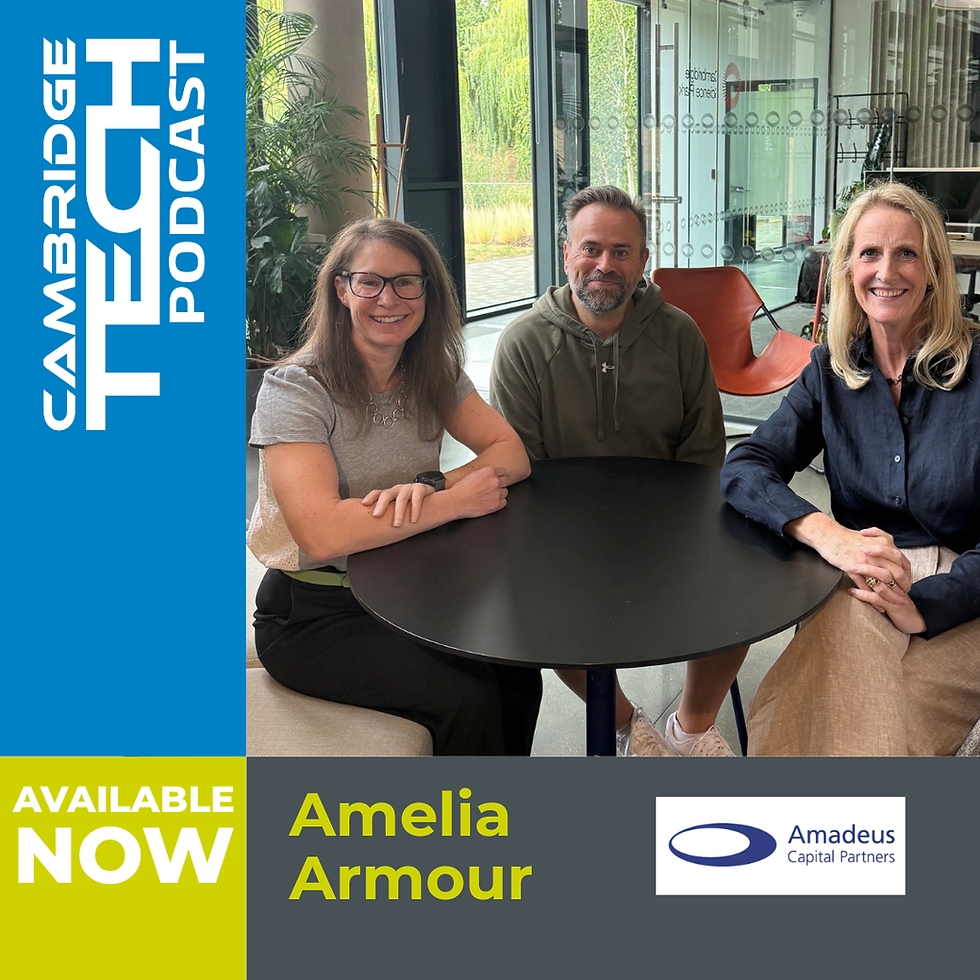
Show Notes 191: From Barbecue Chat to Unicorn Trajectory: How CUSP AI is Revolutionising Materials Discovery
When Debs Toms met Chad Edwards at a casual barbecue in early 2024, neither of them could have predicted what would unfold. Two years on, CUSP AI has raised over $130 million, assembled a world-class team across Europe, and is tackling some of humanity's most pressing challenges through AI driven materials discovery. It's the kind of origin story that makes you question whether you've been to the right barbecues lately.
The Tech News You Need to Know
Before diving into the main interview, the podcast opened with a solid week of Cambridge tech headlines:
Nyobolt secured $60 million to accelerate ultra-fast energy technology for autonomous machines and AI infrastructure
Aviva is investing £30 million in a dedicated R&D hub at Cambridge Science Park, creating 500 roles by summer 2027
Barocal (University of Cambridge spinout) raised $10 million seed funding for next-gen cooling technology
Arm continues its stellar performance with record Q4 results and a 14% stock surge, proving its data centre chip strategy is paying off
Angel Academe and the British Business Bank are co-investing £1 million to support female founders in healthcare and tech
Why CUSP AI's Story Matters
What makes Debs' journey particularly compelling is her transition from structured corporate roles. Nine years at Deloitte, eight at Marshall Aerospace, to the controlled chaos of an early-stage deep tech startup. Her insight?
"You have to get very comfortable very quickly with just not knowing all the answers."
The company itself represents a genuine breakthrough. CUSP AI has built an agentic platform that models material properties with extraordinary speed. Where traditional materials discovery involves years of laboratory work with a mere 6% success rate, CUSP AI can deliver equivalent results in 45 minutes with a projected 90% success rate.
Key Milestones in Two Years
Company incorporated March 2024
Seed round closed June 2024
First platform version live January 2025
Series A raised over $100 million (preempted during a team retreat in Wales—yes, really)
Team grown to 55 employees with contracts signed for more across UK, Amsterdam, Berlin, and London
Real-World Impact That Matters
CUSP AI isn't building technology for technology's sake. Their partnerships focus on genuinely transformative applications:
Carbon capture through direct air capture (DAC) projects with Meta
Forever chemicals removal from water in partnership with Khmera, a NASDAQ-listed Finnish company
Next-generation batteries and semiconductors addressing real infrastructure challenges
As Debs notes, there's genuine purpose embedded in the work: "The loveliest thing about that project is our lead chemist working on that project was actually pregnant at the time and is really aware that this is something that is impacting human life."
What's Next?
CUSP AI is expanding aggressively into Asia-Pacific with a Singapore office and partnership already in motion. They're announcing new talent hires and partnership deals over the coming months, with an ambitious goal to deliver best-in-class materials by year-end.
For founders and investors, CUSP AI's story offers several lessons: the importance of mission-driven teams, the power of combining deep technical expertise (Max Welling's world-leading AI research) with commercial acumen (Chad Edwards' background), and the value of building based on what customers actually need.
Listen to the full episode to hear Debs discuss the mental health implications of AI tools, why Cambridge needs to do more for AI talent, and how she maintains culture whilst scaling at breakneck speed.
AI generated transcript
00:03
Speaker 1
Welcome to the Cambridge Tech podcast, talking all things technology from the heart of the UK's tech capital. Here are your hosts, Faye Holland and James Parton.
00:28
Speaker 2
Hi, I'm James.
00:29
Speaker 3
And I'm Faye. So, James, did you have a good week last week?
00:32
Speaker 4
Yeah, really good.
00:33
Speaker 2
The launch of the Start Cambridge proposition has gone really well and I've been approached by a couple of other organizations who want to come on board. So I'll share more on that once everything's finalized. Lots of planning, so more Trinity Prize, Bradford Prize Planning held, the biannual Bradfield Steerco, which is always nice to switch gears from the operational to the strategic thinking. More Cambridge Tech Week planning. And I'm probably going to London Tech Week. Are you going?
00:59
Speaker 3
Yeah, I think from the partnership point of view, we're going to be going to the Global R and D Summit, which is co located, so we'll be there for a couple of days. It's already pretty jam packed, but whether I actually make it over to the main London Tech Week event, I'm not entirely sure.
01:14
Speaker 2
I'm not 100% confirmed, but I think it'd be good to go and experience it again and maybe bring back some tidbits for the podcast. So, yeah, I'll confirm as soon as I can. How was your week?
01:26
Speaker 3
Yeah, it was good. I mean, we started with a bank holiday again last week and thankfully mine was slightly less dramatic than the previous bank holiday shenanigans that happened. It was a really busy week last week. We've got a big board meeting this week, so I was getting everything ready. So I was very headstone in the office, which is just, it's like really unusual to be just office based for. For kind of four solid days. But I did manage to get out and about as you would expect in the evenings though. So I did one event with the Director General of the British Chambers of Commerce, Siobhan Haviland, who was here speaking at a Cambridgeshire Chamber event up in Ely Cathedral, which was absolutely stunning. It was a debate on is the UK a great place to do business.
02:12
Speaker 3
So how would you have voted in that debate? Not having heard the arguments, but.
02:16
Speaker 4
Well, I was gonna say, you're putting.
02:17
Speaker 2
Me on the spot there. Of course I'm gonna have to say yes, of course it's a great place to do business. But what was the vote?
02:22
Speaker 3
Well, I voted no. I know, I know. It really was quite spicy. Not because I don't believe it's a great place. I just believe that we can do better and we've kind of controversially may a little bit of. We're blaming this perma pressure that seems to be happening all the time now. So we're blaming that, we're blaming the government, whereas actually we just need to get on. So I, I voted no and 55% of the audience voted no, which was, you know, I mean, it's still going slightly the wrong way, but I think it probably just is a very good reflection of sentiment at the moment. But we then very much did, you know, and all of our social posts afterwards, like we need to change to a do now attitude rather than just complaining about things.
03:11
Speaker 3
So that was my Tuesday evening last week. I did have a rant on LinkedIn if anyone wants to read about it. And then on Thursday evening, it was the annual Cambridge Independent scitech Awards, which I went to.
03:22
Speaker 2
It was, yeah, I believe you were sitting next to Mr. Mark Watson. So how did that go?
03:26
Speaker 3
Yeah, it's become a ritual that we sit next to each other on the front row. So I'm always happy to continue that ritual. But we did behave ourselves, you'll be pleased to hear.
03:37
Speaker 2
Did he present himself with an award this year or did he learn from last year?
03:41
Speaker 3
No, no, he presented beautifully. He did a very good job. Very good job. It was a good evening. There was a slight technical hitch that we all just sat and waited for, but Paul Brackley, he was great. He just completely rode with it and it was totally fine. Everyone got an extra opportunity for a bit of a chat. But, yeah, there were some good winners there as well. Some good contenders. Cambridge Nucleomics, you'll be pleased to hear, was highly commended in the start of the year category, which was basically full of 21 to watch. So I sat there brimming with a little bit of pride. Trimtech Therapeutics took the gong in that category. Rob Walden was there. He was up for Tech for Good with Youth to Save, which obviously we've covered on the podcast. And there was Muhammadan and Rebecca there from Curate.
04:28
Speaker 3
They were up for a medtech Company of the Year award and I did talk to them and we're going to get them back on for a double act sometime soon as well, because they're going to have some good news to announce shortly. There were some really new companies as well. So I've never heard of Finkel, Pulpex, Avalari, W Park, and Four Colors Research. Any of those ring a bell to you?
04:49
Speaker 2
WPARK rings a bell, but I'm not sure why.
04:52
Speaker 3
Yeah, they're out of the judge. So I think they're one of the judge programs that was the one. It had a degree of familiarity, but I think they're just starting to, you know, come out a little bit more. So those I thought were, I mean, Pulp X, really interesting company and quite a lot of funding. So they've obviously just got on, done the job and, you know, they're progressing quite nicely. And I think that kind of reflected the whole of the evening, to be honest. The winners were really wide ranging. So you'd got Redgate for software, you've got Plestechs, you've got Jump Tech, which I think is a Bradfield center tenant as well. Luminance. But there's all this like, it's a eclectic mix of industries, but also size of company, stage of company. Tough job for the judges to try and select from.
05:40
Speaker 3
How do you choose between one that's very early stage and one that's got tens of millions of pounds raised?
05:48
Speaker 5
So that was interesting, I think.
05:51
Speaker 2
I mean, the thing I love about, I mean, we're blessed in Cambridge to have a number of different awards, aren't we? And it's almost like a soft KPI, I think, for the podcast that, you know, have we spoken to these winners as they get announced on the podcast before? And actually we do a pretty good job of that, don't we? And you know, editorially we like you were saying with the judging of the awards editorially for the podcast, we always have to decide that balance between talking to super early stage companies and the more established larger companies. And it feels like we're doing a pretty good job of that. So let's give ourselves a pat on the back.
06:22
Speaker 3
Yeah, okay, we'll, we'll do that. And then so that the last pat on the back that we have to give was to Sir Greg Winter, which you will also be very pleased to hear. He won the lifetime achievement award. Honestly, his talk at the beginning was just so funny, so engaging, as enigmatic as he would always be. And he was like, you know, the whole jokes of lifetime achievement awards by default are for old people. But he was quite happy about it because he said that once he won a Nobel Peace Prize, all of the other awards dried up. He was, he was, he was obviously really gracious, really funny and, you know, it was great to him recognized like that.
07:06
Speaker 2
Well, one of the best anecdotes I've got of Greg, obviously, for those that don't know Greg is the chair of our judges at the Trinity Bradfield Prize and I had a hilarious 15, 20 minute conversation about the merits and challenges of owning a moat around your house. So that's an interesting problem I never considered before.
07:25
Speaker 3
I mean really never crike it,.
07:30
Speaker 2
But yeah. So moving away from moat news, should we move on to the tech news for the week?
07:36
Speaker 6
Let's do it.
07:36
Speaker 2
Okay, so our first story is Cambridge innovator Niabolt, who are a pioneer in ultra fast high power energy technology, announced last week it has raised $60 million to accelerate the development pipeline and bring its power performance solutions to the autonomous machines that need them most. The round was led by Nasdaq quoted Symbiotik, a leader in AI enabled robotics technology for the supply chain with participation from cbmm, Latitud, IQ Capital and Scanner Invest. The raise follows a period of rapid commercial momentum with nybolt revenues growing five times year on year, reflecting the demand surge across physical AI applications and AI data center infrastructure. So congratulations to the team there.
08:19
Speaker 3
Indeed. So next up to one of our oldest technology companies in the Cambridge cluster, Aviva. They are investing about 30 million pounds in a dedicated R D hub based at the global HQ on the Science Park. The new hub will bring together more than 500 roles in the one building and is expected to be fully open in summer 2027 in time for Aviva's diamond anniversary. CEO Casper Herzberg said our investment in Cambridge reflects the exceptional talent, growth and industrial intelligence capabilities that define the region. This also aligns with the long term vision that has established Cambridge as a global technology leader.
08:58
Speaker 2
Bar Kohl, the University of Cambridge spinout, has raised $10 million seed round to accelerate development and scale its engineering team ahead of comm deployment. The new cash backing has been provided by World Fund, Breakthrough Energy Discovery, Cambridge Enterprise Ventures and IP Group plc. The money will be used to make key hires and accelerate its commercialization. Barracole says that at scale, its technology will significantly reduce heating and cooling sector emissions through efficiency gains and avoiding gas refrigerants and will initially target fast growing applications including data center cooling and commercial refrigeration.
09:36
Speaker 3
Next up we have updates from arm. The demand for their first dedicated chip for the data center market is already soaring and it's evident in its latest set of record breaking results for Q4 and the full year it pushed the stock up almost 14% to a 52 week high of $237. The financial year ending 26 was ARM's third consecutive financial year since going public of more than 20% revenue growth and previously covered the move into the ARM AGI cpu, its first production silicon product purpose built for agentic AI, which puts it at the heart of the AI infrastructure that will define the next decade of computing.
10:21
Speaker 3
Despite many warnings that ARM is taking a risk at damaging its ecosystem strength with the data center play, many more are saying that this new market is a brilliant landing stage for the technology and the figure has certainly seemed to suggest it's landing well.
10:36
Speaker 2
And another local positive story. Cambridge funders are playing a key role in helping to address the imbalance in funding for female founders in healthcare and technology in the UK. British Business bank has committed an initial 1 million pounds to co invest with Angel Academy, a founding signatory of the Investing in Women code. The funds, managed by Syndicate Room in Cambridge in partnership with Angel Academy, will invest exclusively in high growth companies with at least one female founder. The British Business Bank's capital will be deployed alongside Angel Academy's private investors and EIS fund into startups at seed and Series A stages. And if this is a space you're interested in or relevant to you can listen back to our episode 141, which was this time last year when we spoke to Sarah Turner, who's the founder of Angel Academy.
11:24
Speaker 6
Brilliant.
11:24
Speaker 3
And I forgot to say as well, Syndicate Room were one of the winners at the SciTech Awards for what they're doing around fintech. So good year for them. That's it for the news recap from last week, so let's move on today's episode.
11:40
Speaker 4
Yeah.
11:40
Speaker 2
And today we're joined by Debs Toms from Cusp AI, a company using AI to discover entirely new materials that could transform industries from energy to computing. You're going to love this one.
11:57
Speaker 6
Hi, Debs, welcome to Cambridge Tech Podcast.
11:59
Speaker 5
Hi. Thank you very much for inviting me.
12:01
Speaker 6
Not a problem at all. So it's great to have you with us and we're going to talk obviously about all things CUSP AI and the tech and all those kinds of things. But let's start by talking about you a little bit because I'm really interested to know how you got to be chief of Staff. I love that job title. How did you get to be that? And at one of the most exciting companies coming out of Cambridge at the moment.
12:25
Speaker 5
Wow. Most exciting companies. It really is that. It has been a complete roller coaster. So I'll start by talking about my background a little bit because I think that helps explain why I'm doing that role. So I started off as a tax advisor At Deloitte. I spent nine years at Deloitte, had an absolutely wild time, really fun, working with incredible companies in the Cambridge tech space. So generally I was working with the smaller companies. So taking them from startup or out of Cambridge University to IPO, some IPO'd, some sold, some liquidated, as is the journey. And I think I got to play a part in some really exciting work there. So I did the Horizon Discovery ipo. Obviously, this is quite a few years ago. Blue Gnomes sailed to Illumina, Convergences sail to Biogen. So some really exciting at the time, big deals.
13:17
Speaker 5
But you're always watching from afar and you always feel a little bit removed from the excitement of being in it. So I always knew that this was somewhere where I wanted to end up. I left Deloitte and then joined Marshall Aerospace. So really great company. Had a lovely time there. I was there eight years, probably did eight jobs in that time. Moved from tax into finance, then even border roll into just general advisory. And then I had a long period of some difficult personal grief and decided I need some time out. And so I left Marshall. That was in February 24th. And my plan was to not work for the year I had. My little boy was four at the time. He was going to go to school in September.
14:00
Speaker 5
So I was like, I'll take the rest of the year off and then once he's gone to school and he's happy, I'll find a new role. That didn't happen. Two weeks later, I met Chad Edwards, he's our CEO, and I actually met him at a kid's barbecue and he started talking about what he was doing and what he was building. I have to say, I didn't know very much about AI at all the time, but he informed me that he was building an AI company and they had a term sheet for $20 million and that Geoffrey Hinton was working with them. So I didn't know anything about AI, but I definitely knew who Geoffrey Hinton was. So Chad wanted some just general help in how do you set up companies? How do you get a VAT return? How do you employ people?
14:42
Speaker 5
So I offered to help. I joined in March 24th. We didn't raise the seed until June 24th, so I actually offered to work for free until they raised the seed. The best decision I've ever made. I did get paid because we did raise the seed.
14:55
Speaker 6
That's brilliant. And what was it like, the transition to finance? Because I guess it's much more structured. Tax finance, very structured to having this Random conversation at a barbecue and finding yourself now@Cusp AI. What was that transition like?
15:11
Speaker 5
Yeah, so I think the move from tax to finance was easier than the move to finance to everything, because you've got rules, you're following a rules based system more generally and you've got a structure, you've got your deep technical knowledge which you can rely on. Whereas now the depth and breadth of the role is so huge. In one moment I might be having a people conversation about strategic people decisions, the next moment I'm deep in attack technical workflow, trying to work out what a VAT return should say. So the depth and breadth is absolutely huge. I think you have to get very comfortable very quickly with just not knowing all the answers. And that means I've built a huge network of people that can just help. And that's in a formal way, so lawyers, solicitors, but also in a really informal way.
15:58
Speaker 5
I have some incredible colleagues and people that I've met in the Cambridge industry, Cambridge network, because people are really generous with their time and really happy to help.
16:08
Speaker 4
So related to that, I think there's some perceived kind of wisdom, for want of a better expression, that it's hard for corporate people to transition into startups. Because you have guide rails, don't you? You have set jobs and job descriptions in corporates, whereas in very early stage startups it's a roll your sleeves up and just get stuck in kind of mentality. So it takes a special kind of person to be able to come out of that corporate environment into a startup environment. How did you find that transition?
16:32
Speaker 5
Yeah, that's a really interesting question. I think I've always been somebody that, whilst I was at big corporate, so I was at Deloitte, which is a huge company, and at Marshall, which has 2,000 people, seven jurisdictions. I've always been someone who enjoys the noise, who enjoys making simplicity out of chaos. I'm at my best when everything's going a bit wrong, actually. And that's not to say that in a startup everything's going a bit wrong. It's that in a startup, every single day something will hit you, which you didn't expect. But I thrive on that. It's a roller coaster, it's fun again, I have amazing people around me who support in the right way when we need it.
17:12
Speaker 4
And I love it. It's so Cambridge to have that conversation at a barbecue. We should be keeping a list of all of these chance encounters, shouldn't we? We've had pubs, barbecues, lots of them.
17:21
Speaker 6
So you've Just said you thrive in that level of chaos a little bit and that's how you thrive. And also transitioning from your previous roles into an area you knew pretty much nothing about, how did you actually get up to speed as quickly as possible so you could start tackling some of those challenges?
17:40
Speaker 5
Yes, I think it depends on the type of challenge. I was in an environment where I had a very broad view of the types of operational challenges that I'll have. So I already had a broad view on people things, finance, that's obviously my background, tax structuring. So those things, if I don't know the answer, I can find the person who will be able to help me with that answer. And sometimes you have to recognise there is no right answer. Actually, if there's nothing else I've learned in the last two years is that you can ask 10 people, get five different answers, and then you've just got to go with what feels right and be comfortable doing that from a technical perspective in terms of the machine learning and the chemistry. I listen to hundreds of podcasts.
18:26
Speaker 5
I am a podcast fiend, so I listen to technical ones like Latent Space Maxwelling was just on that recently. Max is our cto, and also lots of general informational podcasts. The rest is politics, the rest is history, the rest is money. Those types of things where I just get a sort of more general understanding of the environment around me and how that's impacting what we're doing every day.
18:53
Speaker 4
Yeah, that's really interesting. Obviously, Cambridge Tech podcast as well.
18:56
Speaker 5
Absolutely.
18:57
Speaker 4
Obviously.
18:57
Speaker 5
I actually listened to Cambridge Tech when I first took on this role. It was really valuable to me to get to know the ecosystem and the network, because obviously, as I was just explaining, I was in this ecosystem 10 years ago, not now, and it was really helpful. And I actually work with some of the people now that were on your podcast.
19:14
Speaker 4
Lovely. We haven't paid you to say that at all.
19:16
Speaker 6
So why don't you tell us a.
19:17
Speaker 4
Little bit more about the founders? Because obviously it was a bit of a leap of faith from a barbecue conversation to work for free, so you must have brought in really quickly to the idea. So, yeah, tell us about Chad Edwards and Professor Max Welling.
19:29
Speaker 5
So Chad Edwards is a doctor himself, so he comes from a chemistry background and has a PhD in chemistry. He worked in Quantum previously, so he was at Google Quantum before, which is where he met Marcus Hoffman, who's now our cso. And then helped build Quantinium Cambridge Quantum computing as it was then. So he joined them when they had 12 people and grew it to the 500 people and then left to come and work at CUSP. Professor Max Welling is one of the world's most cited deep learning researchers. He's a leading voice in AI for science and built some of the foundational technology which is actually used for generative AI. He's also one of the most humble people you've ever met. So it feels very strange talking about him in that way. He's absolutely brilliant, leader, visionary. Him and Chad are the perfect team.
20:23
Speaker 5
Chad has this superpower of being able to turn the technology and science into something that's really relatable and understandable, which is why he's really strong in the commercial area. And so with Max's deep technical expertise, they're a fantastic pair.
20:39
Speaker 6
Okay, so a serious trio we've got going on here with the three of you right at the start. And then I guess before we go into what CUSP AI does, just to preempt, something else we're going to talk about is the phenomenal journey that you've gone on in such a short amount of time. So my question is, how did it come about? How did this idea come about and why do you think it has taken off so quickly?
21:07
Speaker 5
That's another maybe slightly serendipitous moment, I think. Chad was at Cambridge Quantum Computing, he'd built that to 500 people. He had two children and realised that the world was moving in a very difficult way. He was worried about energy, worried about climate change and wanted to ensure that. When his kids asked him in 20 years time, what did you do, dad? The answer wasn't watch the plane crash. And Max was in a very similar position. He'd been at Microsoft, he'd been working in big tech, and I think he recognised that politicians weren't necessarily going to fix this for us. And so both independently came to the idea that they had realized that the technology was in the right place for AI, for materials to work and have global change, global impact.
21:59
Speaker 5
They'd met each other previously when they were at Microsoft and Quantinium and somebody mentioned to Chad that Max had left Microsoft. So he got on the phone as quickly as he could and yeah, they both independently come to the idea that they wanted to start a startup and so they found each other and as I say, the perfect pair.
22:19
Speaker 6
So there was that degree of purpose and relevance and obviously ability. But how did they know that the system was fundamentally broken or was it just it needed to be improved? What was that impetus?
22:32
Speaker 5
So I think the timing was Perfect. We'd reached a tipping point in technology where generative models could be applied to physical science problems. I think they both realized that not enough companies were focusing on this and that the two of them could really make a difference here. When we started two years ago, we didn't have a huge number of competitors. We do now. There's new ones every single week, new companies doing material science every single week. Some of those are slightly different because they vertically integrated quite quickly, but the time and the technology is ready. When were looking to fundraise, I said that we had a $20 million term sheet that became $30 million quite quickly. Investors were excited about seeing the opportunity for AI to make real change. Everybody's used the chatbots and everybody's used nanobanana to create pictures.
23:25
Speaker 5
Of course, nanobanana didn't even exist then because we're moving so fast, but you get the idea. Everybody was aware of what it could do in a social media context, but was surprised and excited to see what it can do in a real world context.
23:39
Speaker 4
That's really good background. Don't segue into talking about the actual technology and what you guys actually do. So it's all about using AI to speed up the discovery of new materials, is that right?
23:50
Speaker 5
Yeah, that's correct. So we've built a platform that allows us to design, develop and create new materials. So the platform is an agentic platform. It works like a search engine for materials discovery. So you can enter the properties that you want in a material. So how can so the conductivity or synthesis ability, stability, cost, or even if there's materials that you don't want to use because of, for example, toxicity, you put in the properties into that engine and it will design you a new material. So we have access to huge databases of materials. So almost all of the material publications available we have access to. So the agent knows that it needs to go and research all of those to tell us in the material space what materials might have those properties.
24:46
Speaker 5
But it searches all known materials and then generates new novel materials based on the known materials properties. Then there's a human in the loop who can go in and look at those generated materials. They can visualize them on the platform. So whereas with us looking at a generated image, we can see if someone's got two heads. Obviously that's much harder for material science. So we need the experts, the chemistry experts to go in there and they have a look at the materials that have been designed. They can see where all the different structures are and how they join together. And they can see if they're valid or not. If they are valid, they can then ask the agent to run a synthesisation. It creates a recipe that we can then use to design the material in real life.
25:32
Speaker 4
For the uninitiated, could you compare your system to the traditional method of material discovery and just kind of highlight the advantages of the AI driven model?
25:42
Speaker 5
Yeah, absolutely. So the traditional method of materials discovery is have an idea, you create it in a laboratory, you find out once you've built it whether it works or not. I think generally there's a 6% pass rate there and it might have taken you years and millions of dollars. So we can now use our platform in 45 minutes to deliver what would have been a four year PhD. It's absolutely game changing, which just allows us to move faster, allows you to remove waste from the process because you've got much more likelihood of it being successful. So we think we can get to a 90% success rate.
26:21
Speaker 4
I guess using the amount of money you've raised as an indicator, you've clearly got something exciting and unique here. What's really amazing to me is just the speed that you've managed to train the AI, because if you're getting this kind of result and the money's flowing into back it. How old's the company? Two years.
26:39
Speaker 5
We don't actually know how old we are, which is absurd, isn't it? So it's a different number depending on what you want to choose. The company was incorporated in March 24. We raised our first seed round in June 24. In September 24, we had our first meeting of employees. There were five of us. We really started building January 25 and by June 25 we had version one of the platform up and running. Our Series A got preempted, we raised another over a hundred million dollars and ended up where we are today.
27:11
Speaker 4
Yeah, you gave a hint to some of the sources that you're using to train the AI. But the secret sauce has got to be in that speed and its ability to act on that input.
27:22
Speaker 5
The secret sauce is the talent of the team that we've managed to build. So Max himself is, as I said, absolutely world leading in this. And the team he has built around him, of ex PhD students, people who know him, people who've worked deeply in this field, has meant that we can do it that quickly.
27:40
Speaker 4
You talk about 45 minutes instead of four years, you're only two years in. So what does this look like in another two years?
27:47
Speaker 5
Time to run a full project. So for A customer project, the first design phase takes six months. The phase after that which would be actually building. So the synthesis is about 18 months and we need three or four people to run that. In the next two years we can be running that with one person. We still really believe that the human in the loop is really important. We're not looking to create something that's fully agentic because actually the real specialism here comes from the AI speeding up the data processing and speeding up that piece of information. But it's those people that have been working in these laboratories, in our customers for years and years on end and have such a deep knowledge of the product that they are trying to create that we rely on to make that platform work.
28:35
Speaker 4
And in terms of real world application in can you talk to us about some of your kind of customers and the kinds of use cases or materials that you're already helping those customers with?
28:45
Speaker 5
Yeah, absolutely. So we are really trying to focus on the world's toughest challenges. So reducing carbon from the air, developing next generation batteries, semiconductors, and they're all material science problems at their core. There is some irony in using AI to resolve semiconductor problems, but we really believe that if we want to solve the world's biggest challenges, that's the way to do it. We work across a number of business units that we call internally frontiers. So there's really three main areas there. The first is surfaces and separations, which is any material that binds something, separates it, protects it, adhesives, new plastics, those types of things. The second is catalysts and conversions, which is materials that would drive clean energy, carbon conversion. And then the third is semiconductors, as I said earlier, so materials that enable us to have faster computing, more efficient power.
29:42
Speaker 5
We've been working with a number of different customers. Meta was the first partnership we ever engaged in and that was right at the beginning. Most people know Meta for the fact that they work on social media and that kind of area of them. They also have a really strong materials team that was run by Jan Lecun, he's one of our advisors and we worked with them to open source a project to release a number of data points for materials that could be used for dac, for carbon capture. So direct air capture. Probably the most exciting one and the one that's closest to my heart is working with Khmera. So they're a Nasdaq Finnish water company, NASDAQ listed Finnish water company and they have come to us with one of their hardest problems. They actually found us from our press release.
30:30
Speaker 5
We didn't go and look for them, which is incredible. And they contacted us because they really want to find a way to remove forever chemicals from water. So you might have watched Dark Waters and these kinds of movies, and that's a real problem. So something that lots of teams across the world are trying to fix and something that's very important for us to try. The loveliest thing about that project is our lead chemist working on that project was actually pregnant at the time and is really aware that this is something that is impacting human life and is really aware that it's something that was quite close to her heart. So it felt really special to be able to work on something that's so important.
31:08
Speaker 6
Everything you've just said really fits into that whole purpose driven approach that you've talked about. And I just find it a little bit mind blowing that we're sitting here and you're talking about all these things that have happened in this two year period. And the fact you've got those partnerships in play and running is again, an incredible achievement, isn't it? And it's showing that it's real, demonstrable, real life activity.
31:36
Speaker 5
Yes. It's not until you sit here and talk through these things that you realize what has happened in the last two years and what an incredible honor it has to be part of it. I think we always knew when we started for Chad, it was exceptionally important to always build based on what companies need and what's commercially necessary. We didn't want to be one of those companies that goes into a deep build, takes five years to build a platform, comes back up with something that feels wonderful but doesn't actually serve the purpose. So we use working with customers that we actually call partners for a very specific reason. And that wasn't anything we ever decided. It just feels right that we don't really use the term customers.
32:24
Speaker 5
So we always wanted to work with partners so that we knew from day one that were working on something important. It allows us to ensure that as we're building the platform, we've got a very specific use case that we can be testing as we build. The platform is material agnostic, but allowing us to do it in this way allows us to broaden the material set that the platform is capable of dealing with as we build it. So we built it initially for metal organic frameworks or MOFs, and that allowed us to do the carbon capture project. And as we take on each different partnership, we expand it to a different class of materials.
33:03
Speaker 4
Can I just ask a supplementary question there? So when you discover a new material for a partner, does that become their intellectual property? Is that then their material or how does that work?
33:13
Speaker 5
So the way our model works is we work in partnership with a customer to build a material. The customer then owns that material, but we have royalty rights over it too. So our model is a royalty model.
33:25
Speaker 6
So I want us to come back to the funding. I can't just let those comments you made earlier just go. By raising two rounds, 30 million, then 100 million within 18 months, probably less than that, is extremely impressive. What was that roller coaster like? And you've also got a lot of investors. What's it like managing and interacting with all of those people now on the table?
33:52
Speaker 5
I have a few really strong memories of those fundraisings. So the seed round, I guess the strongest memory for me is the first time actually money came in the bank account. We'd been trying to set up this bank account for such a long time and then suddenly it existed and suddenly there was money in it. And I remember texting Chad and Max, because at the time it was just the three of us, because were only focused on the fundraising at that time. That one didn't feel it was just hugely exciting, but it didn't feel, like hugely stressful or a really difficult fundraiser, which seems really unfair when it's 30 million and people struggled so hard to fundraise.
34:34
Speaker 5
It was so successful because of who Chad and Max are, because the idea was so different at the time and because of the board and advisory board around them that they had built. Even at that time, even before they did that, the Series A was very different because the team is disparate, so we have people in different countries across Europe. Every six months we meet and we have a week away together. And because Chad is from Wales, last June, were all in Wales together for a week. We were actually camping in the grounds of a castle. It was fortunately beautiful weather all week, otherwise we might have regretted our decision. The lead investor had come to visit Chad and Max on the Friday before that, just for an introductory meeting. And then we received a term sheet over the weekend.
35:24
Speaker 5
So weren't expecting to be doing a Series A from tents in a garden castle in Wales.
35:31
Speaker 6
It sounds perfectly normal, right?
35:34
Speaker 5
Normal for us. Yeah, absolutely. The garden actually had an old greenhouse where all of our investor meetings were held.
35:44
Speaker 6
That's a new course of a week.
35:46
Speaker 4
There's gotta be some growth or incubation puns there as well.
35:48
Speaker 5
Oh, well done. Very good. So, yeah, so we had a strange week of. Every morning, Chad would turn up to the day's sessions with, guys, we got a term sheet last night. Guys, we've got this much money this morning, guys, this morning it's this much. Yeah. Within four weeks we'd closed at over a hundred million dollars. There was definitely moments in that one. I think probably because we had the team at that point, because were all much further invested, our hearts and souls have gone into this. There was moments when I remember being sat at home on my computer knowing that an investor meeting was happening for sign off or something like that and just really not being able to breathe because there's nothing you can do to fix that.
36:38
Speaker 5
Normally, as I said, I'm at my best when I've got a problem to fix, but when I can just sit and wait for it and I cannot do anything to fix it, that's very difficult. So, yeah, definitely some fun times on that one.
36:50
Speaker 6
And then the managing them. So you've got an awful lot of people now that are investing in the business. What's it like? Because that adds an additional level of complexity to you as chief of staff as well.
37:03
Speaker 5
We're really lucky that we've got a great board of investors. So we've got different types of investors. So NEA and Temasek are our lead. They both bring different things to the table. But I couldn't enjoy working with them both more. They're extremely supportive, extremely hands on, extremely helpful. We have some investors from our seed round that have stayed with us and again, I don't think I realized how helpful investors can be, but in a really different way. So these guys are on WhatsApp whenever we need them. I didn't realize that all fundraisers and all investor conversations are done over WhatsApp, often with emojis as well. It's really something really supportive and really wonderful. We've then got another set of investors who are strategic investors. So Hyundai NVentures and Samsung, we report to them on a regular basis, but they're less hands on.
38:01
Speaker 5
And then we've got a huge stream of angel investors who are the brightest minds and the best names you could possibly ever want as your angel investors. And they're all really different. So some of them are really hands on, some of them really helpful. Lots of them bring us talent or introduce us to other investors. But we have been extremely lucky with our investor base.
38:24
Speaker 6
Yeah, no, brilliant. And you just talked a little bit throughout all of that about the team and the fact that you are dispersed across lots and lots of different locations. You've got a Huge task in front of you, so you must be recruiting like crazy. You've already grown. So how are you finding the challenge of talent and recruitment?
38:47
Speaker 5
Somebody said to me the other day that you must know that you're growing really fast when if somebody asks what your headcount is, there's two answers. There's we've got 45 people today and we've got 57 signed contracts. And it wasn't till they pointed that out to me that I realised how fast that growth is and how much it takes to manage it. So we've been careful and we try to be careful over how fast we're growing. It doesn't sound like it if we give those numbers, but we have core teams in the uk, Amsterdam and Berlin. Initially, as I said earlier, they are the teams that often came with Max. They're his hand picked chosen talent and they are generally the majority of the AI team.
39:32
Speaker 5
We've then built our chemistry team in London and Cambridge because actually it's the easiest place to recruit really strong chemists. We use slack all day, every day to keep connections. We have an all hands every Tuesday morning and then we have this cusp conference retreat every six months to make sure that all the teams stay together. In terms of recruitment, we only have 55 people, roughly as I just gave you those numbers. But two of those are recruiters on recruitment because we're trying to be careful over how we grow. We will only recruit and advertise roles where there's a real burning need. We never want our recruitment to overtake the commercial partnerships that are ultimately going to bring in the revenue. So we're very cautious on our Runway. That said, we are always looking for really strong talent, particularly in chemistry and machine learning.
40:28
Speaker 5
We look to recruit people who are highly mission driven, highly curious and really collaborative. It's very important to us that everyone in our team has a view. Everyone on our team has a valuable view. What's really incredible right now is because we're quite small, every single person who joins within a week, you can see the difference that they've made, which is just exceptional. It's so inspiring.
40:53
Speaker 6
And how do you think you're going to be able to continue that culture? I think you can, but how do you think you can continue that culture? Because you've obviously got a real dynamic, an environment that you've built and everyone is just slotting into. How are you going to be able to maintain that?
41:11
Speaker 5
That's what keeps me up at night.
41:13
Speaker 6
Right.
41:13
Speaker 5
It really is. How do we keep A company where everybody cares so much. I find it very hard to describe how thoughtful and kind everyone is and how much people really care for each other. It's not a value on a wall. We actually don't have values on the wall. We're just. That's another of the things I haven't got around to doing. It just feels special. It's nothing like I've ever seen before. And I think we have a careful recruitment process to really drive that out. When we're recruiting, there's some hugely brilliant technical minds that I'm sure would have exceptional careers. But if they're not thoughtful, they're not kind, they're not curious, and they don't want to collaborate, there's a wonderful somewhere else that they can work. And that's really hard. It's hard to keep the bar.
42:02
Speaker 4
That's really interesting. Before we move off the team and culture side of the questions. Feels like this is becoming a standard question now, doesn't it? Because it's cropping up in a lot of these interviews. But you're obviously an AI company, but how are you thinking about AI internally to help grow the company? We've spoken to a lot of founders on the podcast recently who are almost reliant now on AI to scale the business in lieu of having to hire traditional roles. Right. So listening to how important culture is to you as a business, how are you making that balance and how does AI play a role in the growth of the company?
42:38
Speaker 5
I use AI all day, every day, for everything. I cannot tell you how big the team would need to be if we didn't have it. I think we've got the benefit of the fact that we are only two years old. So Chatbots. Claude is my best friend. They existed as we built, so we've used them from day one. So I will have multiple Claude open with multiple different questions, all working on different things. It gives us another problem, though. So we noticed last year that we had posted four times the amount of code that we technically should have done for the team size that we had. And as I said, I've. From an operations perspective, I use it for absolutely everything. But it's made us be really cognizant of the impact it has on your mental health.
43:26
Speaker 5
If you're using these times of chat box all the time, they don't give you the slow thinking time that doing a task the normal way or the old way gives you, and that's becoming a real problem. So it's something that we're really conscious of. Is how do we keep the efficiency that AI provides for us, but in a way that's healthy.
43:50
Speaker 4
That's interesting. Okay, as you mentioned, you've got a distributed team, employees in lots of different countries, you come together regularly, which clearly is important. Do you feel like it's a Cambridge company? What's it like building the business in Cambridge and what are the benefits of being in Cambridge?
44:05
Speaker 5
Is it a Cambridge company? We are a Anglo Dutch company. We describe ourselves as a European company and that's really what it feels like. We have the benefits of being in Cambridge, we have the benefits of Cambridge being this incredible ecosystem where people know each other, they're generous with their time. There's something special about the Cambridge ecosystem that I've yet to be able to define. As a side note, I run something called the Founders Table with a great friend of mine, Amanda Nunn. We built this because we both realised that doing the jobs where you're filling in the blank sheet of paper and you've got the breadth and depth of a role that I described earlier is really hard. And we wanted a safe space for people who are founders, builders, operators to talk, have dinner.
44:58
Speaker 5
It's a dinner club essentially, and to just share thoughts, share ideas and help each other. Particularly on those questions where there is no right answer, like I discussed before. And we've held a couple in Cambridge, but we held one in Oxford recently and it was really different and it's really hard and we can't work out why. We believe there's spaces like the Bradfield Centre that don't exist there, that are actually so imperative to just bringing people together. I think they have smaller spaces where if you've got five people, you can fit, but there's nothing. Once you've got five or 10 and you have to move into your own office, there's the expense of doing that. So actually what we noticed was people were having to inhibit the growth of their companies because they couldn't afford to do that.
45:44
Speaker 5
That because it can't afford to take on a three year lease. But there's something special about the Cambridge networks that really does help grow a company.
45:54
Speaker 4
Do you feel Cambridge is genuinely a leading AI cluster, not just for the uk, but globally? Are you seeing that in the kind of talent conversations that you're having and the quality of the researchers?
46:06
Speaker 5
I feel it should be, oh, interesting. We actually had to open our London office because we couldn't compete with London for AI talent. We have the benefit now of we don't have a London and a Cambridge office. I keep saying this, it's just we have a UK office, we have a Dutch office and we have a German office. We very strategically built our London office at King's Cross because it's right on the train to Cambridge and right on the train to Amsterdam. I think there is more Cambridge could do to bring talent from King's Cross. Unfortunately, that train is sometimes just a little bit too far.
46:43
Speaker 6
I just have to say, David, Cleveland has actually renamed King's Cross. It's now Cambridge South.
46:48
Speaker 5
Yes, that makes a lot of sense. Absolutely. I can see it.
46:52
Speaker 6
Just keeping that land grab going.
46:54
Speaker 5
Absolutely. Why not? Why not?
46:56
Speaker 6
Sorry, James, did you have a sensible thing to.
46:59
Speaker 5
Rather than my.
46:59
Speaker 4
I'm not going to get involved in renaming parts of London, but that need to go into London for AI talent. Is that because you're looking to cherry pick people from existing companies that are based in London? Is it? London graduates? Where's that kind of pull coming from?
47:15
Speaker 5
Unfortunately, our competitors are Google Meta Wave. They're companies with more money, they're companies with more resources. And whilst we can compete on the mission. Absolutely we can. To compete on the mission and then ask people to commute. Some of these people might already live in South London, so to then ask them to commute two hours to Cambridge was more difficult.
47:35
Speaker 4
No, that makes sense.
47:36
Speaker 6
And we've heard that before. Beyond math, companies like that, they've done exactly the same thing. So ultimately you've got to grow the business, so you've got to go work. You get the talent from the right place, haven't you? So Deb's just an outstandingly interesting conversation. I'm almost dreading asking this question because it's been such a whirlwind first couple of years. There's unicorn status literally on the horizon here. What's your next big milestone?
48:02
Speaker 5
So from announcement perspective, over the next couple of months, we will be announcing some new talent, we will be announcing some new partnerships we are expanding into. So we're a Europe based company now. European based company. We're expanding into AAPAC and the US. Our first Singapore employee started in April and we're building that team there. Our Singapore team is based on a partnership that we signed just before Christmas. A really strong partnership with the Singapore team that we'll be announcing shortly. And then. Yeah, more materials. Our goal is to have a best in class material designed through our agent this year.
48:46
Speaker 4
Yeah, amazing. I think Faye said it all in terms of just how impressive the company story is. The velocity of the company. If people aren't already following you and want to stay in touch with what's going on there. How do they get in touch? They follow along.
49:00
Speaker 5
There's other podcasts you can listen to. Sorry guys. Very sorry guys. They do exist. Maxwelling has done a latent space podcast which is much more technical. For those technical listeners who would want to listen to that, we have just released a YouTube site and we've got one video on there so far, but we will have more. So our YouTube video is Max Welling interviewing Martin Van Der Brink, who is one of our advisors. He was the chairman of asml, who make the lithography machines which build chips that AI compute is all built on. And they have a great conversation around just doing really hard things like the technology that we're doing. So that's a great video to watch. And then yeah, Follow us on LinkedIn is the best place.
49:47
Speaker 5
Our website will being built over the course of this year, so LinkedIn is definitely the best place.
49:53
Speaker 4
Awesome. Thanks so much for taking time out. You must be super busy. We appreciate it.
49:57
Speaker 5
Thank you very much guys.
50:47
Speaker 1
Today's show was produced by Joe Donaghy of Cambridge TV and supported by our media partner, Business Weekly. The Cambridge Tech Podcast is available on all major podcast platforms and on cambridgetechpodcast.com if you've enjoyed this podcast, please give it a five star review. It'll really help others discover the show. Technology moves fast and now so can you. Discover Polestar, the all electric performance brand vehicles redefining how we drive. Precision engineering, minimalist design and software that evolves with you. Experience it at Holden Group in Norwich and Bury St. Edmunds or let us bring the test drive to your door. Proud sponsors of the Cambridge Tech Podcast Polestar Electric Performance Redefined discoveroldengroup.co.uk Polestar.
Transcribed by https://fireflies.ai/

To listen and subscribe, search for ‘Cambridge Tech Podcast’ on your favourite podcasting platform or visit cambridgetechpodcast.com.